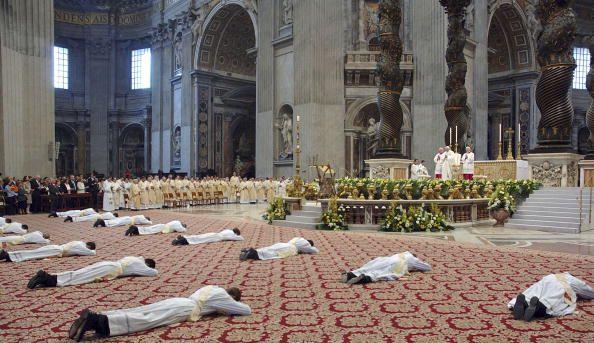
I'm lifting this directly from Bryan Cross' blog, Principium Unitatis. I had read the print article but hadn't seen the video footage until today. As an Eastern Catholic my heart's strong desire is to see these Orthodox Christians who are so close to communion with Catholics bridge the gap needed for us to share a meal at one common table. What a testimony to those who doubt this would be? There is so much confusion about all of the various groups who call on Christ--and I believe that with each barrier that is broken, the light grows more.
Bulgarian Orthodox Leader Affirms Desire for Unity
VATICAN CITY, OCT. 22, 2009 (Zenit.org).- A Bulgarian Orthodox prelate told Benedict XVI of his desire for unity, and his commitment to accelerate communion with the Catholic Church.
At the end of Wednesday’s general audience, Bishop Tichon, head of the diocese for Central and Western Europe of the Patriarchate of Bulgaria, stated to the Pope, “We must find unity as soon as possible and finally celebrate together,” L’Osservatore Romano reported.
“People don’t understand our divisions and our discussions,” the bishop stated. He affirmed that he will “not spare any efforts” to work for the quick restoration of “communion between Catholics and Orthodox.”
Bishop Tichon said that “the theological dialogue that is going forward in these days in Cyprus is certainly important, but we should not be afraid to say that we must find as soon as possible the way to celebrate together.”
“A Catholic will not become an Orthodox and vice versa, but we must approach the altar together,” he added.
The prelate told the Pontiff that “this aspiration is a feeling that arose from the works of the assembly” of his diocese, held in Rome, in which all the priests and two delegates from every Bulgarian Orthodox parish took part.
“We have come to the Pope to express our desire for unity and also because he is the Bishop of Rome, the city that hosted our assembly,” he stated.
H/T: Overheard in the Sacristy
Saturday, October 24, 2009


Sunday, October 18, 2009
Prayer
I found this quote from Father Stephen Freeman's Blog, Glory to God for All Things.
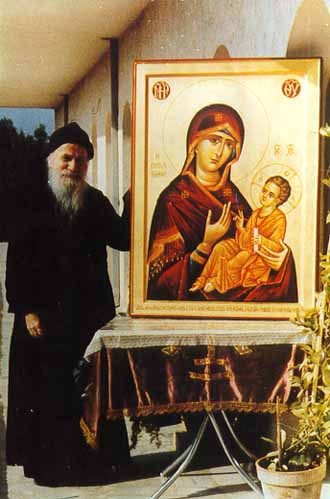
Pray for those who make accusations against you. Say, ‘Lord Jesus Christ, have mercy on me’, not ‘have mercy on him’, and your accuser will be embraced in this prayer. Does someone say something to you that upsets you? God knows it. What you have to do is open your arms and say, ‘Lord Jesus Christ, have mercy on me’, and make your accuser one with yourself. And God knows what is torturing your accuser deep inside of him and, seeing your love, he hastens to help. He searches the desires of hearts. What is it that Saint Paul says in his Epistle to the Romans? He who searches the hearts knows what the mind of the Spirit is, because in accord with God He makes intercession for the saints.
Pray for the purification of each and every person so that you may imitate the prayer of the angels in your life. Yes, the angels don’t pray for themselves. This is how I pray for people, for the Church and for the body of the Church. The moment you pray for the Church, you are released from your passions. The moment you glorify God, your soul is calmed and sanctified by divine grace. This is the art I want you to learn.
The Elder Porphyrios from Wounded by Love.

Pray for those who make accusations against you. Say, ‘Lord Jesus Christ, have mercy on me’, not ‘have mercy on him’, and your accuser will be embraced in this prayer. Does someone say something to you that upsets you? God knows it. What you have to do is open your arms and say, ‘Lord Jesus Christ, have mercy on me’, and make your accuser one with yourself. And God knows what is torturing your accuser deep inside of him and, seeing your love, he hastens to help. He searches the desires of hearts. What is it that Saint Paul says in his Epistle to the Romans? He who searches the hearts knows what the mind of the Spirit is, because in accord with God He makes intercession for the saints.
Pray for the purification of each and every person so that you may imitate the prayer of the angels in your life. Yes, the angels don’t pray for themselves. This is how I pray for people, for the Church and for the body of the Church. The moment you pray for the Church, you are released from your passions. The moment you glorify God, your soul is calmed and sanctified by divine grace. This is the art I want you to learn.
The Elder Porphyrios from Wounded by Love.
Thursday, October 1, 2009
Friday, September 25, 2009
Thursday, September 24, 2009
A new blog post for Called to Communion--check it out!
http://www.calledtocommunion.com/2009/09/is-paedocommunion-a-step-towards-heresy-or-orthodoxy/
Saturday, September 19, 2009
the Trisagion.....
Ἀμήν.
Ἅγιος ὁ Θεός, Ἅγιος Ἰσχυρός, Ἅγιος Ἀθάνατος, ἐλέησον ἡμᾶς.
Ἅγιος ὁ Θεός, Ἅγιος Ἰσχυρός, Ἅγιος Ἀθάνατος, ἐλέησον ἡμᾶς.
Ἅγιος ὁ Θεός, Ἅγιος Ἰσχυρός, Ἅγιος Ἀθάνατος, ἐλέησον ἡμᾶς.
Δόξα Πατρί καὶ Υἱῷ καὶ Ἁγίῳ Πνεύματι.
Καὶ νῦν καὶ ἀεί καὶ εἰς τοὺς αἰώνας τῶν αἰώνων, Ἀμήν.
Ἅγιος Ἀθάνατος, ἐλέησον ἡμᾶς.
----
Amen.
Holy God, Holy Mighty, Holy Immortal, have mercy on us.
Holy God, Holy Mighty, Holy Immortal, have mercy on us.
Holy God, Holy Mighty, Holy Immortal, have mercy on us.
Glory to the Father and to the Son and to the Holy Spirit.
Both now and ever and unto ages of ages, Amen.
Holy Immortal, have mercy on us.
Beckwith Interview

I remember listening to this interview in audio format two years ago as of next Thursday.
It was shocking at the time and I was going through so much, it feels as though it was 20 years ago.
Thanks be to God for men and women like Beckwith who search for the truth no matter where it leaves them.
Thursday, September 17, 2009
Bazan Interview
"...I perceive that God exists, I'm only about half the time comfortable with that perception...."
Sunday, September 13, 2009
Saturday, September 12, 2009
Heavy Breath and Creation

Heavy Breath
the walls of our house
are thinner than paper
the roof is a vapor
that hangs in the air
and our wedding bed
is made from the same stuff
our bodies are made of
if no heavy breath blew up these lungs
while dirt and wet spit hung a ghost in the air
well, we’re still here
while kids and their friends
make war by the fire
their old men retire
to drink and do drugs
we long for the truth
we argue about it
but most of us doubt
it can ever be found
is a ship without a captain just as doomed
as a ship without a crew
‘cause of all my friends who try to tell the truth
there are still a faithful few
who insist they won’t know what to do
if no heavy breath blew up these lungs
while dirt and wet spit hung a ghost in the air
well, we’re still here
There is some amazing imagery of Adam and Eve in this song (the album version is fuller than this live recording, which is stripped down and lacks the interesting vignette about ships without captains and crews), and I hadn't caught it until I thought about the lyrics more.
I also really appreciate the tie in between Christ healing the blind man (a re-creation, if you will) and that original act of creation. And yes, like his friends I still insist that I wouldn't know what to do, if no heavy breath blew up these lungs while dirt and wet spit hung a ghost in the air.

Wednesday, September 9, 2009
Tuesday, September 8, 2009
Monday, September 7, 2009
Sunday, September 6, 2009
Wednesday, August 19, 2009
Why the first council of Nicea shows a non-Protestant view of the world (and why you should care), part III
(Note: I will be adding many more comments, but am mad about my lack of productivity so am forcing myself to post this in an incomplete form. But Canon 13, oh Canon 13!)
Let's look at another Canon a lot later in the list of Canons:
Canon 13
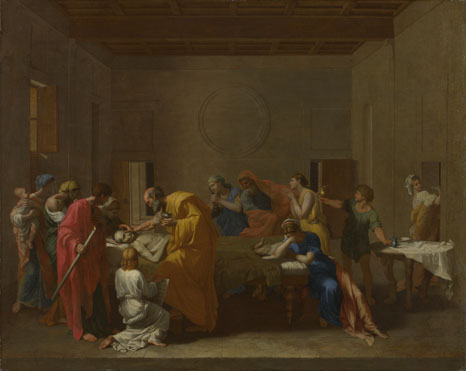
Concerning the departing, the ancient canonical law is still to be maintained, to wit, that, if any man be at the point of death, he must not be deprived of the last and most indispensable Viaticum. But, if any one should be restored to health again who has received the communion when his life was despaired of, let him remain among those who communicate in prayers only. But in general, and in the case of any dying person whatsoever asking to receive the Eucharist, let the Bishop, after examination made, give it him.
If we are rightfully accused of believing in Magic, as some have done---if we are making more out of the Eucharist than those who consider it merely symbolic would say we are, why would the first Ecumenical council make sure that NO ONE be deprived of the Eucharist on their way out of the earth?
Monday, August 10, 2009
Why the first council of Nicea shows a non-Protestant view of the world (and why you should care), part II
After introducing the problem in my previous post, I'd like to bring up what strikes me most about Nicea and the way that this council has a view that does not comport with Protestantism. Many Catholics have gone about this debate by centering their thoughts on some of the final clauses of the Creed, and if I have the time I may conclude by stressing that to really believe in one baptism for the remission of sins, and a Church that is One, Holy, Catholic, and Apostolic does not match the typical Protestant view of the Church, but I think that the context surrounding this Creed is even more compelling.
For you see, this council is indeed the point where Arianism was repudiated and the deity of Christ was upheld, in that great distinction which was made between homoousion (the same essence as that of the Father) and homoiousion (a similar essence as that of the Father's). But it was not merely a council that discussed this matter of who Jesus is and his relationship to the Father.
Not only was there a Creed that was written and approved at Nicea, there was also a set of Canons (or rules) about Church behavior and polity. It is these Canons about which I found myself both greatly amazed and instructed in history as I read them recently. It was so encouraging to see that my faith as a Catholic was upheld historically in the very first Council. But then, I'm getting ahead of myself, as usual.
So, the first Ecumenical Council met, and it didn't just make a Creed. It also set out to write some Canons. We can imagine a hush in that ancient hall, and what will be decreed in the First Canon? If you guessed a further condemnation of Arianism, you would be wrong. In fact, if you randomly were to guess the right answer I would ask you to go to a grocery store and buy me some lottery tickets. This first Canon at the first Council states the following:
If any one in sickness has been subjected by physicians to a surgical operation, or if he has been castrated by barbarians, let him remain among the clergy; but, if any one in sound health has castrated himself, it behooves that such an one, if [already] enrolled among the clergy, should cease [from his ministry], and that from henceforth no such person should be promoted. But, as it is evident that this is said of those who wilfully do the thing and presume to castrate themselves, so if any have been made eunuchs by barbarians, or by their masters, and should otherwise be found worthy, such men the Canon admits to the clergy.
First and foremost, I was shocked to read that this act of self-mutilation was not a random blip confined only to the life of Origen, the early Church Father who had some strange views at times.
This phenomenon was actually frequent enough that the Fathers of Nicea had to speak out against it and say that those men should not be in the ministry! If only our age erred in that realm in that area, versus the dominance that lust plays in the Church and outside of Her doors. But that's another story for another time.
Going beyond that, it really strikes me that this first Canon is considering the treatment of eunuchs and how they, if not self-mutilated, can be a member of the clergy. Why discuss this, if being a pastor "requires" that the man who is ordained must be the husband of one wife?
Instead, there is the assumption that there should be a place for men who live as celibates. And why do you think some people had castrated themselves? It's simple logic to see that some men wanted to be in ministry and could not imagine living a chaste life without this mutilation taking place. Now, many married men may think this to be so, but in the midst of all this consideration which may seem too theoretical, some simple words from Our Lord come to mind:
For there are eunuchs, which were so born from their mother's womb: and there are eunuchs, which were made eunuchs by men: and there are eunuchs, which made themselves eunuchs for the kingdom of heaven's sake. He that is able to receive it, let him receive it. (Matthew 19:12)
Now, perhaps some of our 4th century Christian friends had taken this passage literally? Maybe that's why there were some people who had castrated themselves? This may especially be true if also they took Christ's words about cutting things off that cause one to sin literally, but the point is that this Canon shows that that is not what Christ meant. To make one's self a eunuch for the Kingdom of heaven is instead an interior act of devotion to God above any earthly affections. That there would be some celibate men in the priesthood or serving as bishops/deacons/etc. is clearly presupposed by this Canon.
And yet, as I've asked many friends, I cannot find a local Evangelical or Reformed congregation where Pastor so and so has decided to live a celibate life in dedication to God. Instead, such a man would be suspect as being somewhat freakish. Even an unmarried pastor who has the intention of finding a godly wife is suspect. I'm not saying that all priests should be celibate (and indeed, there are married priests in Eastern Catholic and Eastern Orthodox Churches, as well as some rare exceptions to the rule when Anglican priests and others convert to Roman Catholicism), but the more I have considered this canon, the more it has been clear that a significant portion of men in the ministry were celibate.
The first Canon of Nicea takes it for granted that there are these men who are eunuchs for the sake of God, and welcomes those men who have been mutilated by others into the ministry. That just sounds far too Catholic for my former Protestant ears. Am I alone?
At this point you may be asking, "So what? So what if this council was completely different in its thinking from my way of thinking?"
The significance of this issue includes these facts:
1) If the Protestant view is right and the view of Nicea is wrong, that means that the Church was already corrupt in its first big meeting after the Scriptures were written.
2) This writing goes presupposes a view held by Catholics and Orthodox, who also stress their connection to the Apostles in terms of apostolic succession.
3) It raises the question of why this issue of celibacy even seems strange, given the passage in the Gospel mentioned above.
Or maybe you're hoping that this dissonance between Protestant thinking and Nicene thinking as seen in Canon I isn't really that big of a deal, and this first canon is just an aberration. As my next post will show, the lack of harmony between the Christian community of 325 and its Protestant counterparts today cuts even deeper than this issue of celibacy.
Saturday, August 8, 2009
Why the first council of Nicea shows a non-Protestant view of the world (and why you should care), part I

Various online and in person debates have led me to think about the idea that the perspective of the Apostolic Churches, both Western and Eastern, is not anachronistic in looking to the first Christians who lived after the Apostles, and seeing a similar tune being sung by them. We are told by our Protestant friends that if we would just look at the really early Church, then all of our distinctives such as Apostolic Succession, the office of a bishop who can ordain people in parishes where he is not the pastor, an almost magical view of the sacraments, and the like, are contrivances that aren't in Nicea, but are in places like Trent. But is that true?
The Nicean Creed is something affirmed by all Trinitarian Christians (to my knowledge, at least), and this council is supposedly from a time when doctrine had not developed to the point where Protestants would take exception. Or so it would seem. Even though as a Presbyterian we would often recite these words, for various reasons I would argue that this council is not fair game for all Christians.
For now, here is the text of the Creed, as said by some Eastern Christians:
I believe in one God, the Father Almighty, Creator of heaven and earth, of all things visible and invisible.
And in one Lord Jesus Christ, Son of God, the only-begotten, born of the Father before all ages.
Light of light, true God of true God, begotten, not made, of one substance with the Father, through whom all things were made.
Who for us men and for our salvation, came down from heaven, and was incarnate from the Holy Spirit and Mary the Virgin, and became man.
He was also crucified for us under Pontius Pilate, and suffered and was buried.
And He rose again on the third day, according to the scriptures.
And He ascended into heaven, and sits at the right hand of the Father.
And He will come again with glory, to judge the living and the dead, and of His kingdom there will be no end.
And in the Holy Spirit, the Lord, and Giver of life, who proceeds from the Father, who together with the Father and the Son is worshipped and glorified, Who spoke through the prophets.
In one, holy, catholic and apostolic Church.
I profess one baptism for the remission of sins.
I expect the resurrection of the dead; and the life of the world to come.
Amen.
AMEN....
Wednesday, August 5, 2009
In Honor of Some Upcoming Weddings
"The principle is this: that in everything worth having, even in every pleasure, there is a point of pain or tedium that must be survived, so that the pleasure may revive and endure. The joy of battle comes after the first fear of death; the joy of reading Virgil comes after the bore of learning him; the glow of the sea-bather comes after the icy shock of the sea bath; and the success of marriage comes after the failure of the honeymoon. All human vows, laws, and contracts are so many ways of surviving with success this breaking point, this instant of potential surrender.
In everything on this earth that is worth doing, there is a stage when no one would do it, except for necessity or honor. It is then that the Institution upholds a man and helps him on to the firmer ground ahead. Whether this solid fact of human nature is sufficient to justify the sublime dedication of Christian marriage is quite another matter, it is amply sufficient to justify the general human feeling of marriage as a fixed thing, dissolution of which is a fault or, at least, an ignominy. The essential element is not so much duration as security. Two people must be tied together in order to do themselves justice; for twenty minutes at a dance, or for twenty years in a marriage. In both cases the point is, that if a man is bored in the first five minutes he must go on and force himself to be happy. Coercion is a kind of encouragement; and anarchy (or what some call liberty) is essentially oppressive, because it is equally discouraging. If we all floated in the air like bubbles, free to drift anywhere at any instant, the practical result would be that no one would have the courage to begin a conversation. It would be so embarrassing to start a sentence in a friendly whisper, and then have to shout the last half of it because the other party was floating away into the free and formless ether. The two must hold each other and do justice to each other. If Americans can be divorced for "incompatibility of temper" I cannot conceive why they are not all divorced. I have known many happy marriages, but never a compatible one. The whole aim of marriage is to fight through and survive the instant when incompatibility becomes unquestionable. For a man and a woman, as such, are incompatible."
G.K. Chesterton
In everything on this earth that is worth doing, there is a stage when no one would do it, except for necessity or honor. It is then that the Institution upholds a man and helps him on to the firmer ground ahead. Whether this solid fact of human nature is sufficient to justify the sublime dedication of Christian marriage is quite another matter, it is amply sufficient to justify the general human feeling of marriage as a fixed thing, dissolution of which is a fault or, at least, an ignominy. The essential element is not so much duration as security. Two people must be tied together in order to do themselves justice; for twenty minutes at a dance, or for twenty years in a marriage. In both cases the point is, that if a man is bored in the first five minutes he must go on and force himself to be happy. Coercion is a kind of encouragement; and anarchy (or what some call liberty) is essentially oppressive, because it is equally discouraging. If we all floated in the air like bubbles, free to drift anywhere at any instant, the practical result would be that no one would have the courage to begin a conversation. It would be so embarrassing to start a sentence in a friendly whisper, and then have to shout the last half of it because the other party was floating away into the free and formless ether. The two must hold each other and do justice to each other. If Americans can be divorced for "incompatibility of temper" I cannot conceive why they are not all divorced. I have known many happy marriages, but never a compatible one. The whole aim of marriage is to fight through and survive the instant when incompatibility becomes unquestionable. For a man and a woman, as such, are incompatible."
G.K. Chesterton
Subscribe to:
Posts (Atom)