Showing posts with label contrarian contemplations. Show all posts

Thursday, October 16, 2008

our present hope, our future glory, our deep connection - II


"I believe in the communion of the saints."

This simple clause in the Apostles' Creed means so much more to me as a Catholic than it did as a Protestant. It's an underlying basis for explaining why Catholics and other Christians are not ashamed to call on saints in heaven to help those on earth.

In my last post on this issue, I decided to heap up what I see as the crucial data from Scripture that clarify who we will be one day. I wanted to follow up on this concept by taking a simpler approach.

Instead of quoting Church Fathers and establishing precedent from the Catholic Church, I think a very helpful approach is to see things from the other group's side. Stepping into someone else's shoes, it may be possible to show how even their view of the world is amenable to one's own view.

To really step into these shoes, I am going to quote a song that only a few in this world know. It's quite silly, but still I know that the majority of my friends from my home town who would care about this debate will remember its words.
I quote the part that I remember most clearly:
"more like you
less like me
make me more and more like you
less and less like me.
more like jesus
less like me-sus
at your name i bow my knees-us
to do what my master pleases"

Now I would probably faint if I ever stepped into a Catholic parish and heard this song being played, and there was a large period of time where I made fun of this entire genre and wrote it off completely.

But on a fundamental level, what do we as Christians mean when we utter such words? We understand what our Lord has in store for us. There is an element in which this will be true in this life, but most of us understand that ultimate transformation into His image will find its fulfillment on the other side of the grave.

Does this transformation undo our connections to each other?

How could we not be closer after this transformation?

Similarly, if you were to become more like Jesus would that make you more or less fervently passionate about helping your brethren? Would your prayer life resemble Our Lord in Gethsemane or the disciples who slept while He prayed (which is more often than not my own status)?

If these things are true, how much love must our brethren in heaven have for us?! We have only a glimpse of how much love and concern they must have for us, based on the moments when we die to our selves and live in union with Jesus. May those moments grow in depth and intensity, but the point is.....there is full union in heaven. What must that say about our departed brethren?

How could they worship our God who ever lives to make intercession for us and discard the same passion that He has for us while in His presence?

How could they not give Him glory by imitating Him. We do it here, why would they not do it there?

This brings us to the fundamental objection that saints in heaven can't hear us because of their finitude. True, they are finite, but they are united and transformed by the all-consuming love of the Father. Just as John felt compelled to worship the glorious angel who brought him messages in the book of Revelation, we would probably fall over if we met a saint who has been glorified.

If we will know even as we are known in heaven, what would that say about our grasp of the earth? That's the theme I hope to convey in a future post, but for now, consider what it means to be more like Jesus and less like "me-sus".

Monday, September 29, 2008

Saints Michael, Gabriel, and Raphael, pray for us!

On the Church calendar, today is the Feast of the Great Saints who are Angels, Michael, Gabriel and Raphael.


St. Michael triumphing over Lucifer-putting Revelation into sculpture.
Revelation 12:7-8, "And there was a great battle in heaven, Michael and his angels fought with the dragon, and the dragon and his angels fought back. But he was not strong enough, and they lost their place in heaven."

Here is a traditional prayer to St. Michael the archangel.

Saint Michael the Archangel, defend us in the day of battle. Be our protection against the wickedness and snares of the devil. May God rebuke him, we humbly pray, and do thou, O Prince of the Heavenly Host, by the power of God, cast into hell satan and all the evil spirits who prowl about the world seeking the ruin of souls.


As new Catholics, my wife and I have a lot to learn. Last night she asked me why an angel would be called a saint.

In case you share this question, let me answer it here - the Greek word for saint is hagios, which means holy one. An angel that is not fallen is clearly a holy one, and as a result it is quite fitting to bestow this appellation of saint upon an angel.

At any rate, I was starting this blog thinking of my dear Protestant brothers and sisters. As Presbyterians, our worship service would invariably begin with the singing of the Doxology. I reflected on these words as I heard a Latin song sung after Mass today. The melody was the same as the Doxology, and while I understand Latin when read I had no text to read.

So my mind turned to the words we once sang on a weekly basis.

Here they are:

Praise God from whom all blessings flow!
Praise Him all creatures here below!
Praise Him above ye heavenly host!
Praise Father, Son and Holy Ghost!
Amen

It was at that point that the notion of praying to the saints, of communicating to them while they are in heaven, was nothing new in becoming Catholic. It was there all along, admitted or not, at least in some corners.

Praise Him above, ye heavenly host!

And so, whether you admit their help in your life, I call upon the angels of the world to continue to praise Him and minister to us all as the first chapter of St. John's gospel records that they did to our Lord.

49Then Nathanael declared, "Rabbi, you are the Son of God; you are the King of Israel."

50Jesus said, "You believe because I told you I saw you under the fig tree. You shall see greater things than that." 51He then added, "I tell you the truth, you shall see heaven open, and the angels of God ascending and descending on the Son of Man."

Thursday, September 25, 2008

G.K. Chesterton on Confession


When people ask me, or indeed anybody else, "Why did you join the Church of Rome?" the first essential answer, if it is partly an elliptical answer, is, "To get rid of my sins." For there is no other religious system that does really profess to get rid of people's sins. It is confirmed by the logic, which to many seems startling, by which the Church deduces that sin confessed and adequately repented is actually abolished; and that the sinner does really begin again as if he had never sinned. And this brought me sharply back to those visions or fancies with which I have dealt in the chapter about childhood. I spoke there of the indescribable and indestructible certitude in the soul, that those first years of innocence were the beginning of something worthy, perhaps more worthy than any of the things that actually followed them. I spoke of the strange daylight, which was something more than the light of common day, that still seems in my memory to shine on those steep roads down from Campden Hill, from which one could see the Crystal Palace from afar. Well, when a Catholic comes from Confession, he does truly, by definition, step out again into that dawn of his own beginning and look with new eyes across the world to a Crystal Palace that is really of crystal. He believes that in that dim corner, and in that brief ritual, God has really remade him in His own image. He is now a new experiment of the Creator. He is as much a new experiment as he was when he was really only five years old. He stands, as I said, in the white light at the worthy beginning of the life of a man. The accumulation of time can no longer terrify. He may be grey and gouty; but he is only five minutes old.

Tuesday, September 23, 2008

our present hope, our future glory, our deep connection to each other


I am currently reading a book called Furrow by St. Josemaría Escrivá. He arranged the book into 1000 points, and in a twist of irony and comedy, point number 666 spoke to me almost more than all the others I had read up to that point. This is what he said:


Those in love don’t know how to say good-bye: they are with one another all the time.

—Do you and I know how to love the Lord like this?


Many people have criticized me for being slightly awkward with personal relationships. I'm not one to say goodbye every time I walk out of the house, for example. And I've always had this sort of intuitive understanding that we're not apart from each other, because of our love for each other. Now, this kind of silly way of pointing to my personal oddities (without excusing all of my deeds, of course) is just a way to call to mind the idea that whether you act like me or not, as friends and brethren we are more deeply connected than we sometimes think.

Thinking in light of this connection, we can go to a grander scale and see how it applies to the idea of where we are, where we are going, and how we are aided by those who have gone on before us.

This is vitally important, as one objection to the Catholic idea of the intercession of the saints on our behalf is that it places powers into our hands which are only rightly God's. For example, His omnipresence enables Him to hear our prayers, and yet Catholics often ask saints in heaven to pray for them. But again, how connected are we?

And more importantly, how connected to God are the saints?

To answer that question, I want to share something that may or may not be familiar with you. St. Athanasius, champion of defending the divinity of Christ against the Arian heresy, also spent some time in the 300s defending something else that may make you feel a bit of unease. To quote him,

"He, indeed, assumed humanity that we might become God."


That sounds quite heretical, but it comes from the mouth of one that Protestants and Catholics alike call a champion of orthodoxy. How do these oddities coexist? To answer that, I want to place some passages of Scripture before you for consideration. In my next post, I will explain how I have come to conclude that these passages not only clarify what St. Athansius meant, they vindicate the practice of the earliest Christians down to those Catholic and Orthodox brethren who have seen fit to ask for prayer from departed saints. For now, think on these words.

As you read, consider where you are now, where you are going, what you want to be, and what the word of God says you will be. Ask whether you have limited the grandeur or the scope of what the Scriptures say is in store for us. And ask for the eyes and faith to see and hold to the great promises, despite your situations that may cloud such a view.

"For those God foreknew he also predestined to be conformed to the likeness of his Son, that he might be the firstborn among many brothers. 30And those he predestined, he also called; those he called, he also justified; those he justified, he also glorified." Romans 8:29-30

"For we know in part and we prophesy in part, but when perfection comes, the imperfect disappears. When I was a child, I talked like a child, I thought like a child, I reasoned like a child. When I became a man, I put childish ways behind me.Now we see but a poor reflection as in a mirror; then we shall see face to face. Now I know in part; then I shall know fully, even as I am fully known." 1 Corinthians 13:9-12


"I declare to you, brothers, that flesh and blood cannot inherit the kingdom of God, nor does the perishable inherit the imperishable. Listen, I tell you a mystery: We will not all sleep, but we will all be changed— in a flash, in the twinkling of an eye, at the last trumpet. For the trumpet will sound, the dead will be raised imperishable, and we will be changed. For the perishable must clothe itself with the imperishable, and the mortal with immortality. When the perishable has been clothed with the imperishable, and the mortal with immortality, then the saying that is written will come true: "Death has been swallowed up in victory."1 Corinthians 15:50-54

"Therefore, since we are surrounded by such a great cloud of witnesses, let us throw off everything that hinders and the sin that so easily entangles, and let us run with perseverance the race marked out for us. Let us fix our eyes on Jesus, the author and perfecter of our faith, who for the joy set before him endured the cross, scorning its shame, and sat down at the right hand of the throne of God. Consider him who endured such opposition from sinful men, so that you will not grow weary and lose heart." Hebrews 12:1-3


"Is any one of you sick? He should call the elders of the church to pray over him and anoint him with oil in the name of the Lord. And the prayer offered in faith will make the sick person well; the Lord will raise him up. If he has sinned, he will be forgiven. Therefore confess your sins to each other and pray for each other so that you may be healed. The prayer of a righteous man is powerful and effective." James 5:14-16

"His divine power has given us everything we need for life and godliness through our knowledge of him who called us by his own glory and goodness. Through these he has given us his very great and precious promises, so that through them you may participate in the divine nature and escape the corruption in the world caused by evil desires." 2 Peter 1:3-4


"How great is the love the Father has lavished on us, that we should be called children of God! And that is what we are! The reason the world does not know us is that it did not know him. Dear friends, now we are children of God, and what we will be has not yet been made known. But we know that when he appears, we shall be like him, for we shall see him as he is." 1 John 3: 1-2

"My prayer is not for them alone. I pray also for those who will believe in me through their message, that all of them may be one, Father, just as you are in me and I am in you. May they also be in us so that the world may believe that you have sent me. I have given them the glory that you gave me, that they may be one as we are one: I in them and you in me. May they be brought to complete unity to let the world know that you sent me and have loved them even as you have loved me." John 17:20-23

"Then I saw a Lamb, looking as if it had been slain, standing in the center of the throne, encircled by the four living creatures and the elders. He had seven horns and seven eyes, which are the seven spirits of God sent out into all the earth. He came and took the scroll from the right hand of him who sat on the throne. And when he had taken it, the four living creatures and the twenty-four elders fell down before the Lamb. Each one had a harp and they were holding golden bowls full of incense, which are the prayers of the saints." Revelation 5:6-8

"When he opened the fifth seal, I saw under the altar the souls of those who had been slain because of the word of God and the testimony they had maintained. They called out in a loud voice, "How long, Sovereign Lord, holy and true, until you judge the inhabitants of the earth and avenge our blood?" Then each of them was given a white robe, and they were told to wait a little longer, until the number of their fellow servants and brothers who were to be killed as they had been was completed." Revelation 6:9-11


" After this I heard what sounded like the roar of a great multitude in heaven shouting:
"Hallelujah!
Salvation and glory and power belong to our God,
for true and just are his judgments.
He has condemned the great prostitute
who corrupted the earth by her adulteries.
He has avenged on her the blood of his servants." And again they shouted:
"Hallelujah!
The smoke from her goes up for ever and ever."

The twenty-four elders and the four living creatures fell down and worshiped God, who was seated on the throne. And they cried:
"Amen, Hallelujah!" Revelation 19:1-4

"I saw thrones on which were seated those who had been given authority to judge. And I saw the souls of those who had been beheaded because of their testimony for Jesus and because of the word of God. They had not worshiped the beast or his image and had not received his mark on their foreheads or their hands. They came to life and reigned with Christ a thousand years." Revelation 20:4

"And I heard a loud voice from the throne saying, 'Now the dwelling of God is with men, and he will live with them. They will be his people, and God himself will be with them and be their God. He will wipe every tear from their eyes. There will be no more death or mourning or crying or pain, for the old order of things has passed away.'" Revelation 21:3-4

Thursday, September 18, 2008

on the communion of the saints


A very common argument used to object to the Catholic view of the communion of the saints is that the idea of praying to someone who is in heaven but not God is not as good as praying to God Himself.

Many like to construct analogies and say something to this effect:

Suppose you wanted to discuss the President (or CEO, CFO, etc.) of the company. Maybe if you were slightly connected, you would talk to some lower level executives. If you were a lower level executive, the next person you might contact is the Vice-President. But to have a direct line of contact to the President, you would have to be the Vice-President or some other second highest level of command to have such full access.

This hierarchy is compared to the Catholic Church's hierarchy on earth with laypeople, priests, all bishops, with special emphasis on the Bishop of Rome, aka the holy father, the Pope. After death and away from earth, the hierarchy doesn't end, either. For you have suffering believers who are being purged of the inclination to sin in purgatory for whom we are recommended to pray, and the you have saints in heaven, to whom we are recommended to pray. Among the saints in heaven, the Virgin Mary is afforded the highest level of veneration and through devotions such as the Rosary, she is definitely one that Catholics would say is worth contacting.

The person who frames this sort of analogy is quick to make this qualification to the analogy. They would say:

Suppose that you were the son or daughter of this President. Now all objections that could be made by the hierarchy of leadership would fall apart, as daddy's little boy or girl would have the father's full attention. There is no need to schedule an appointment with the VP first, you are instantly accepted by the father.

And thus, the argument concludes by objecting to the Catholic's view of the saints being in communion as including invoking the saints.

But wait a minute! Wait an hour! Please do not pass go with this contortion of reality!

First of all, let's follow the analogy out. OK, maybe Mary is the VP and St. Peter is the Executive Director of Corporate Activities, and so on and so forth.

Even granting that, is that to deny that these believers are NOT children of God??? What a sad way to look at those who are in heaven!

And this brings us on to the second gaping hole in this analogy-its very structure is inaccurate, for the Church is the family of God. Sure, it's a kingdom of priests (1 Peter) and it does have ordained leaders (Matthew 16, Hebrews 12), but God forbid that said leadership get in the way of the bond of love that is the most excellent way of all (1 Corinthians 13)! To start the analogy by describing the family of God as some kind of business is perhaps fitting given the way some Christians make a profit, but it is not what Our Lord ordained, and therefore should not have been the analogy to begin with.

Thirdly, this criticism of the Catholic view is faulty in that it neglects to consider the fundamental relation that is proposed to exist between Christians when they call upon the saint. Look up any prayer to a saint, and you will see this is false.

Take, for example, the Hail Mary. I quote it here:

Hail Mary, full of grace,
the Lord is with thee,
Blessed art thou among women
and blessed is the Fruit of thy womb, Jesus.
Holy Mary, Mother of God, pray for us sinners,
Now and at the hour of our death.

Here we see many things-particularly that the main request of Mary is that she PRAY for us. We as Catholics do not ask Mary to give us this day our daily bread. Secondly, all veneration of Mary is connected to the Lord-she is beautiful because the Lord is with her. God, on the other hand, is to be worshipped and adored, for His name is Hallowed. He is goodness itself. Everyone else is good to the extent that they are in union with Him. But as I said, the real thing that is requested in a prayer to a saint is prayer to the Lord. And this is where another old memory of my Protestant days comes back to haunt me. My calculus teacher stated something so simple that I could only respond by mockery and neglect. He simply asked me, "Jonathan, do you ever ask your friends to pray for you? Does that show that you are not close to God, or that you neglect your own requests made before God? Then neither should praying to a saint."
I couldn't answer him then, and I now find myself on his side.

Fourthly, the whole story that it's better to pray to Our Lord than to pray to a saint offers a false dichotomy. It's a false dichotomy that would fall by the wayside with a moment's reflection-just consider that Catholics pray the Lord's Prayer (or Our Father) and you will understand that the love that we have for our brethren in heaven does not undermine our love for Our Father in heaven. Rather, it is the source of our love for each other, and to the degree that we venerate a saint or a living person, it is to the extent that these people shine forth that image which we all bear-the imago Dei. No, we do not have to choose between praying to saints and praying to Our Lord, any more than we have to choose between loving God and loving our neighbor.

Lastly, I would like to propose a counter analogy, with much fear and trepidation. If it does anything, may it help you to love your brethren on earth more.

Imagine a family where there was a wealthy father who had many children. He gave gifts to all of his children, and would often gather his children together for feasts.

The father sat down at his table, food was passed, drinks were opened, and the candles were lit. Imagine that this meal passed with each child taking turns talking to the Father. His love was so great that he did not mind hearing all of their thoughts and requests. Everyone had a chance to speak to him, and everyone did.

After going to the head of the table, these children sat back down and continued to eat. They did not turn to their left or right to remark about the beauty of their siblings' dress, to ask them for advice, or share the latest joke.

They only longed for the next time to talk to their Father. And in their family, to share with anyone but their Father just did not happen. Call them prim, call them proper, the meal was held in silence, apart from those comments made to and from the head of the family.

At one meal, the oldest child Peter asked the youngest child Mary to ask the father to pass the potatoes. He then proceeded to tell his brother Anthony about his sadness over having lost his favorite shirt. He figured that Anthony would be sympathetic to his story, as he too used to lose items.

In the midst of this discussion amongst the brethren, the Father stood up. The plates clattered with falling silverware, and the burgeoning conversations among the children stopped as silence set in.

"This is not how we operate in our family! After all, I bought the clothes you are wearing, the food you are eating, and the drinks you are drinking! I have given you your very lives! For you to talk to each other about your lives is to assume that I did not give you them, or that your brothers and sisters could actually give you these things! For you to ask someone else to talk to me-that is disgusting! Do you not see that I am here?! Can you not talk to me? How dare you talk to your brothers and sisters!"

And with that, the Father grabbed Peter by the collar and told him to go home for his lack of gratefulness.

Would any of us hesitate to call this man a tyrant?
Friday, September 12, 2008

A Theology of the Body

"From him the whole body, joined and held together by every supporting ligament, grows and builds itself up in love, as each part does its work." Ephesians 4:16


For about two years I have considered writing a series of stories that deal with illnesses and the body. I use this term with hesitation and hope that at some point a better name will come to mind, as a key set of teachings from Pope John Paul II is called the Theology of the Body (and you can read more about it here). While the issues he discussed are more focused on matters of love and marriage, the notion of body permeates his thoughts. His message to the world is far more important than my own reflections, but nonetheless my mind is also drawn to the body from a different angle.

For those of you who do not know me so well, my work has involved considering the body on a genetic level, with a hope that our findings would shed light on why we have various illnesses, so that one day they may be better treated. In studying biology for the past 12 years, I am in many ways fulfilling my childhood wish of understanding what goes wrong when people we love get sick.

Thinking of the verse quoted at the top of this post, it is clear to me that the things which wound the Church as the Body of Christ may be better understood if we better understand what goes wrong in a physical body plagued by various diseases.


So here is the outline for these stories. Each chapter would begin with a real (or realistic) story about someone with a well-known disease. Starting with how one's life is affected by that disease, the story would progress to the level of organs, and then cells, and in some cases understanding what some molecules do to cause illness (without being fully reductionistic, of course). What I think emerges from such reflection is a clearer sense of the problems that we face not only as humans, but as members of one body in Christ.

Just as examples, consider these very brief descriptions, and you will begin to see if it wasn't obvious already that there are many parallels between the physical and spiritual bodies that we either have or comprise.

The caveat I would place on this analogy is that, especially as a Catholic, I would never say that the illnesses that the Body of Christ will suffer will actually cause death (Matthew 16). But that we would be very sick is not out of bounds with Church teaching. At the end of the day, I think each of the following illnesses (and more) characterizes various problems that we as Christians have in our life as one body.


1) Neurodegenerative diseases-the body loses an ability to either communicate to various parts, or parts of the storehouse of memories become destroyed or inaccessible to the body as a whole.
2) Cancer-one part of the body grows beyond its normal bounds, eventually invading other territories and damaging those invaded areas.
3) Heart-related illnesses-the body cannot bring nourishment to all locations for many reasons.
4) Immune deficiencies-the body cannot defend against harmful agents.
5) Autoimmunity-the body decides to attack what is not a harmful agent.
6) Malnutrition-the body is lacking in some factor that is needed for health.
7) Obesity-the body has an overabundance of some factor that is needed for health.
8) Liver and Kidney diseases-the body cannot filter and rid itself of waste properly.
9) Digestive issues-the body cannot process the nutrition that it receives.
10) Allergy-the body reacts to things that do not cause illness as though they do cause illness.


Well, 10 is a round number, but I hope you get a glimpse of what I am considering, and would like to know if this interests you. A friend of mine said that there are so few people who are interested in both biology and theology that the double filter will exclude 99.9% of the population. I think that illness is so ubiquitous that this criticism does not apply, but maybe I'm wrong.

Thursday, September 4, 2008

sola scriptura or sola ecclesia or NEITHER

Many scholars have called Sola Scriptura the formal principle undergirding the Protestant Reformation.

As such, for me the study of Catholicism centered around understanding Sola Scriptura and the evidence for and against it.

If you were to ask me what the strongest passage supporting Sola Scriptura was (as a dedicated Presbyterian), I would respond without thought that 2 Timothy 3 was the key.

Let's read what Paul has to say to Timothy on the importance of Scripture.

14But as for you, continue in what you have learned and have become convinced of, because you know those from whom you learned it, 15and how from infancy you have known the holy Scriptures, which are able to make you wise for salvation through faith in Christ Jesus. 16All Scripture is God-breathed and is useful for teaching, rebuking, correcting and training in righteousness, 17so that the man of God may be thoroughly equipped for every good work.


As a former advocate of Sola Scriptura, I would point out that the Scripture is useful for so much: teaching rebuking, correcting, training in righteousness. The end result, you ask? We will be come a thoroughly equipped person of God ready for every good work.
If we're ready for every good work, how could anything else be needed in our lives? Surely all we need is Scripture?

Now, there are many considerations that have led me to challenge this, such as answering the basic question of what Scripture IS in the first place, but another important consideration/angle came to my while reading a book by Dave Armstrong.

Read this clip of a passage and tell me if you do not see a similar sufficiency from something else.....Imagine Ephesians was somehow destroyed so that the first part of this chapter was destroyed, and we were left with a scroll describing the consequences of some action, but that action (or book) was unclear due to the destruction of the manuscript. We would read:

".........12to prepare God's people for works of service, so that the body of Christ may be built up 13until we all reach unity in the faith and in the knowledge of the Son of God and become mature, attaining to the whole measure of the fullness of Christ.

14Then we will no longer be infants, tossed back and forth by the waves, and blown here and there by every wind of teaching and by the cunning and craftiness of men in their deceitful scheming. 15Instead, speaking the truth in love, we will in all things grow up into him who is the Head, that is, Christ. 16From him the whole body, joined and held together by every supporting ligament, grows and builds itself up in love, as each part does its work."


We see an even fuller declaration of some amazing thing that provides for the full equipping of individuals and these individuals comprising the body of Christ in general to grow up in maturity, but if the manuscript were torn, we would be left to wonder: what caused all of these amazing things? Was this another affirmation of Sola Scriptura?

Well, thankfully, the manuscript was not torn. But at the same time, to the Protestant's dismay, what we read does not speak to the paradigm that a written text is all-sufficient. For we read:

"11It was he who gave some to be apostles, some to be prophets, some to be evangelists, and some to be pastors and teachers, 12to prepare God's people for works of service...."

Here the full read of Paul's argument to the Ephesians shows us that it is the provision of Church Leadership, from apostles down to teachers, that provides all of those amazing blessings.

So what are we to conclude? Would Ephesians alone lead us to say that it's only the Church Leadership that provides us a stable foundation of truth? Well, maybe, but thankfully we have all of the Scriptures to understand that the Scriptures also play an important role.

Thus, just as 2 Timothy does not provide for a paradigm of Sola Scriptura, neither does Ephesians 4 make us think that it is only the Church that gives us truth, as though that occurred apart from the Word of God.

Rather, as custodian of the Word of God, the Church can tell us what is reliable and what is a good interpretation of that Word.

Thank you Lord, for your Word and the leaders that you appointed!

Saturday, August 23, 2008

the eucharist


I have been reviewing a series of lectures by former Presbyterian Minister Scott Hahn. While my chief concern of the moment is to consider the basis (or lack thereof) for a belief in Sola Scriptura, I'm also interested in other points that may be of interest. Yesterday I heard Hahn defending the Catholic notion of the Eucharist using quotations from the Church Fathers, but what was even more exciting was to hear him share his thoughts on how Scripture presupposes the Catholic understanding of the Eucharist. I had considered certain passages discussing the bread of life and the cup of blessing in places such as Paul's letters and John's gospel, but in addition to those words Hahn also pointed to a striking parallel to the liturgical structure of Passover and Jesus' words about certain cups. For example, when he said he would not drink of the fruit of the vine until doing so in His Kingdom (Mark 14), I had always assumed that this had some deep spiritual fulfillment (either in heaven or at the consummation of time). But in John 19 we read of His crucifixion and it's clear that He DID drink of the fruit of the vine while He was on the cross.
That little fact alone should have your interest piqued on the matter, and so I was about to come close to transcribing his arguments on the tape. Thanks to Google, I found an article of his that includes the substance of his arguments. I hope you take the time to consider these arguments here.

Wednesday, August 20, 2008

further silencing of the silent treatment

Recently, I posted on the matter of how thinking about the Deuterocanonical (aka "Apocryphal") books does not just involve the acceptance or denial of particular data on religion, but that it also leads us to realize that God does not leave us for periods of time with no voice except for His written word. But what about periods of time where no authors of the Old Testament lived? There are less gaps in time when one accepts the Deuterocanonical books, but there are still gaps if one looks at when various authors lived. The idea that His fatherly care includes leaving a faithful witness to speak His word orally as well as in written form challenges the principle that since Christ's resurrection we are left to interpret and canonize Scripture on our own. It is the logical conclusion, of course, from thinking that no established religious order such as the Papacy or the priesthood (etc.) would be granted a gift of speaking or interpreting Revelation. But is it valid?


There are many sources of debate on this matter, and I am currently investigating these points of contention. In so doing, I was listening to some lectures on sola scriptura by Scott Hahn, and was pointed to a very interesting passage in the Gospel of John, in chapter 11.

47So the chief priests and the Pharisees gathered the Council and said, "What are we to do? For this man performs many signs. 48If we let him go on like this, everyone will believe in him, and the Romans will come and take away both our place and our nation." 49But one of them, Caiaphas, who was high priest that year, said to them, "You know nothing at all. 50Nor do you understand that it is better for you that one man should die for the people, not that the whole nation should perish." 51He did not say this of his own accord, but being high priest that year he prophesied that Jesus would die for the nation, 52and not for the nation only, but also to gather into one the children of God who are scattered abroad. 53So from that day on they made plans to put him to death.


Here we see that John takes a huge point for granted. He argues that as high priest, Caiaphas spoke prophecy by the nature of his office. Despite the fact that he plotted "eliminating" the problem of Jesus, he was still able to speak prophecy. In a sort of double entendre, Caiaphas' words meant that he was both approving the conspiracy to frame Jesus for a crime and speaking of Christ's sacrifice for our sins.

I do not have the time nor the space to argue whether this gift applies to the Papacy or other extrapolations from this basic point. The main thing that I would ask you to think about is this basic idea of how God has spoken to His people. Many have said that the Old Testament period was one plagued by the faithful fighting the establishment, and that where we stand today is no different. This passage shows that despite personal failings, the high priest of Israel was given a gift to speak prophecy.

It is similar to what Christ said to His disciples in Matthew 23:

1Then Jesus said to the crowds and to his disciples, 2 "The scribes and the Pharisees sit on Moses’ seat, 3so practice and observe whatever they tell you— but not what they do.


The leaders of God's people historically provided a basis for sorting out disagreements by speaking reliable words to the point that even while they opposed Christ, Christ was able to commend their words (but NOT their actions) to His disciples.
And so we see that the idea that history is full of silent periods where we are left with sayings from the past is even further silenced.

Thank you, Jesus, for bringing Your truth to all ages. Open our eyes to see all of Your truth.

Tuesday, August 19, 2008

my "future" patron saint


The Lord knew of the skeptical words that Thomas had previously spoken to his fellow Apostles-another proof of His Omniscience. The wound in His side must have been very large, since He asked Thomas to put his hand into it; so also the wounds on his hands must have been large, as Thomas was bidden to substitute a finger for a nail. Thomas' doubts lingered longer than those of the others, and his extraordinary skepticism is an added proof of the reality of the Resurrection.
There was every reason to suppose that Thomas did as he was instructed to do, just as there was every reason to suppose that the ten Apostles had done precisely the same on the first Easter evening. The rebuking words of Our Lord to Thomas-to be doubting no longer-also contained an exhortation to believe and to shake off his gloom, which was his besetting sin.
Paul was not disobedient to the heavenly vision; neither was Thomas. The doubter was so convinced by positive proof that he became a worshiper. Throwing himself on his knees, he said to the Risen Savior:

My Lord and My God! John 20:28

In one burning utterance, Thomas gathered up all of the doubts of a depressed humanity to have them healed by the full implications of the exclamation, "My Lord and My God." It was an acknowledgment that the Emmanuel of Isaiah was before him. He, who was the last to believe, was the first to make the full confession of the Divinity of the Risen Savior. - From Fulton Sheen's "Life of Christ"

Monday, August 18, 2008

Bouyer on the Gospel


The first book that I read which presents the Catholic view from a positive angle was Louis Bouyer's "The Spirit and Forms of Protestantism".

It is an amazing look at how the positive elements of Protestantism are truly biblical according to Catholic doctrine-namely, the free and unmerited character of our salvation, the sovereignty of God, justification by faith, our personal responsibility, and that Holy Scripture is the highest authority for the believer.

What Bouyer argues is that these seed principles that are positive in character degrade into negative denials of things such as the reality of principle, that grace changes us through justification, and so on and so forth. I would like you to consider this brief passage to get a feel for how he argues, and let me know what you think. Or at least, think about it among yourselves. Ask yourself if your notion of what Catholicism teaches is challenged by this passage. Ask whether this accurately portrays the Protestant view. Most importantly, ask Our Lord to make us one as He and His Father are one.

"Whether it concerns the sola ratia, sola fide, in one or other of its aspects, or the soli Deo gloria, or the supreme authority of Scripture, the negative element arising out of the polemical use of the positive principles seems invariably the same. It was apparently impossible for Protestant theology, as elaborated, to agree that God could put something in man that became in fact his own and that at the same time the gift remained the possession of the giver. Or else, what comes to the same thing, that even after the intervention of grace man could ever belong to God; it would seem as if man could belong to him only in ceasing to have a distinct existence, in being annihilated. That amounts to saying that there can be no real relation between God and man. Barth repeats incessantly that, according to the gospel, there is no way that leads from man to God. The Catholic theologian, contrary to expectation, finds it easy to agree with him in this. His objection to Barth, and to the whole of Protestantism as represented by him, is that he in fact disallows that God can himself come to man. It may be granted that there is no way from man to God that is not illusory. But the gospel is the way of God to man; and the charge against Protestantism, as a system directed against Catholicism, is that, whatever its intention, it does in fact bar this way. If the grace of God is such, only on condition that it gives nothing real; if man who believes, by saving faith, is in no way changed from what he was before believing; if justification by faith has to empty of all supernatural reality the Church, her sacraments, her dogmas; if God can be affirmed only be silencing his creature, if he acts only in annihilating it, if his very word is doomed never to be really heard-what is condemned is not man's presumptuous way to God, but God's way of mercy to man.
This, and this alone, is the ultimate reproach the Church levels at the Protestant system. This the Church refuses to allow, and, in fact, has no right to allow in virtue of the divine word whose sovereign authority is so much invoked. For it is clearly declared false by this word, not in rare and obscure expressions, but on every page; in terms, too, more clearly explained than ever by modern exegesis and relevant to each of the points mentioned, which all derive from the same initial error. The word of God categorically proclaims a grace that is a real gift; a justification by faith that makes man really just; a faith that does give itself, but receives, its content, proclaimed by the krugma [preaching] of the apostolic Church, in celebration of the Eucharist; a God who puts his greatness in giving, giving himself, by a fully effective gift, where there is no question of docetism or legalism, for his Incarnation is no more a pretense or a legal fiction than was the creation-he is the living God who gives life."

Saturday, August 16, 2008

IS PETRUS EST

He is Peter
(the Latin translation of this post)


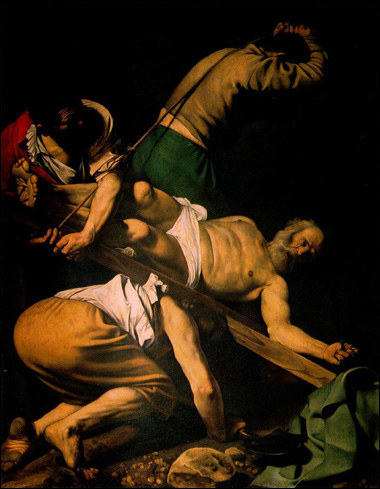
I have been thinking for a long time about considering Church History, and many important arguments about how to get Christians together to debate on fair ground have circulated in places such as here. But in a sense I'm even more interested in asking whether or how a reading of the Bible itself is altered when one is a Catholic Christian. Since a big difference is about the matter of the Pope, I thought it would be interesting to read the letters of Saint Peter and see how beginning a period of time meditating on that portion of Scripture with the knowledge that he is who Catholics claim that he is, the first Pope. As the picture above shows, Tradition also states that he was martyred via crucifixion, but did not esteem himself worthy of being crucified as His Lord was. And so legend has it that he faced the Cross with his head pointing towards the ground.

But what of the greater legend, that he was the first among the bishops? Does a reading of God's word point us in that direction? In sitting down with Peter's two epistles I will say that I was not overwhelmed by this notion. For a while I was slightly unhappy about this experience. Sure, maybe Peter was slightly more humble than the typical conception of a Pope, and so his writings were not overpoweringly emphatic about his position. But was there no glimmer of the truth of his primacy from Scripture? That was when I realized that there are other books in the Bible, and when I turned to the Book of Acts and the Gospels, I found myself overwhelmed. As I hope to explain in coming posts, these portions of Scripture (and even those letters by St. Peter himself) resonate with my newly gained perspective that for there to be unity, the Body of Christ on earth has been given a leader.

Be sure to prod me if I do not update on this, but as I said, this is just the beginning of my journey assimilating my love of the Bible with a love of the Church that gave me those pages. The scrolls that were copied by monks and the councils that stated what the canon was have lived in my heart largely in an abstract sense, and as they are becoming more concrete I look forward to sharing other new ways in which my completion in the faith has led to a more complete grasp of His word.

Or maybe some of you think this is an unnecessary addition. I hope to show that this is not the case, as elements of God's word are examined from the Catholic perspective. For now, my eyes are turned towards the one who turned his gaze upside down. The Church turned the world upside down, and may it continue to turn us all upside down when we are walking on our own notions, for then we will see rightly. As Chesterton put the matter in his biography of St. Francis of Assisi,

If a man saw the world upside down, with all the trees and towers hanging head downwards as in a pool, one effect would be to emphasize the idea of dependence. There is a Latin and literal connection; for the very word dependence only means hanging. It would make vivid the Scriptural text which says that God has hanged the world upon nothing. If St. Francis had seen, in one of his strange dreams, the town of Assisi upside down, it need not have differed in a single detail from itself except in being entirely the other way round. But the point is this: that whereas to the normal eye the large masonry of its walls or the massive foundations of its watchtowers and its high citadel would make it seem safer and more permanent, the moment it was turned over the very same weight would make it seem more helpless and more in peril...Instead of being merely proud of his strong city because it could not be moved, he would be thankful to God Almighty that it had not been dropped; he would be thankful to God for not dropping the whole cosmos like a vast crystal to be shattered into falling stars. Perhaps St. Peter saw the world so, when he was crucified head-downwards.
It is commonly in a somewhat cynical sense that men have said, "Blessed is he that expecteth nothing, for he shall not be disappointed." It was in a wholly happy and enthusiastic sense that St. Francis said, "Blessed is he who expecteth nothing, for he shall enjoy everything." It was by this most deliberate idea of starting from zero, from the dark nothingness of his own deserts, that he did come to enjoy even earthly things as few people have enjoyed them; and they are in themselves the best working example of the idea. For there is no way in which a man can earn a star or deserve a sunset...."

Saturday, August 9, 2008

imagine...


Many people have wrestled and struggled with the Christian doctrine of hell. That some would be excluded from the presence of a God who is good, even if those people had not professed faith in said God, has caused many a furrowed brow and plaintive heart saying "But God, surely you're forgiving enough to let even that one guy into heaven also?"

I had always hoped that maybe at some point those people who did not love God would come to do so when fully in His presence. Maybe on their death beds there is some sort of eye-opening universal experience that removes all doubt and unites all people?

Of course, these considerations are nothing new.
The issue of who exactly winds up in heaven or hell is debated among humans, too often with far too little humility.

And to be honest, I'm not writing here to defend my particular view. I want to delve into the other side of life and give some serious thought to hell as a concept to be denied. For a few weeks ago I took a friend down this road and it was enlightening.

John Lennon expressed this alternative view of life and death well:

Imagine there's no Heaven
It's easy if you try
No hell below us
Above us only sky
Imagine all the people
Living for today


As one who has lived and hoped that the afterlife would make sense of the gross injustices, the first line of this song has always bothered me. Imagine no final reconciliation of those who were tortured and mocked with a loving God? Imagine the scales of justice being horribly skewed towards evil? No thanks, my gut would say. At the same time, that there is no hell appeals to base emotions as well. Living for today is a solution to dealing with the complexities of tomorrow.

Of course, tomorrow has a way of becoming today, so living for today per se cannot be the way.

And so we can see that the denial of the basic Christian scheme of heaven and hell has its own appeals and its own detrimental aspects.

For years I had left this comparison at such a coarse focus. It was one day while philosophizing and smoking cigars that this principle was zoomed into sharper focus, and as usual I was humbled by the clarity of thinking about issues on a simple level.

The conversation began with me discussing my openness to non-Christians going to heaven, which is part and parcel of my growing Catholicism. I thought that this friend who is skeptical of Christianity in general would be pleased to hear that there is a variety of opinions on the matter of hell within the community of believers. But I found that this was not true.

My interlocutor asked me to defend the notion of hell, using similar arguments as those that I just mentioned. Is it fair for so and so to go to hell? What about this religion and that? How dare Christians presume to consign a single soul to the flames of hell? Aren't we all made in the image of God? Doesn't He therefore love us all and why wouldn't he save a drowning soul?

It was at that moment that the words of John Lennon came back to me.

I quoted Lennon in the most unintelligibly intelligible manner possible, but my voice was nonetheless clear.

For the scratchy-voiced Beatle (who had nothing on Paul, to bring up an even more unrelated debate) speaks through his grave as a prophet of our modern mindset. Our 21st century digital thoughts claim to be a warmer and gentler view than the "barbarism" of Christianity.

But what of this claim, that the grave brings nothingness?

It was so clear to me at that moment that even if Christianity leads people to say that some go to hell (in varying numbers, depending on your flavor of faith), that what the song Imagine brings us is a world where we are all damned to hell.

Is not hell the separation of a soul from God? If we have denied our soul, we have denied that we ever were close to God. And even when we say that "today" matters, if tomorrow wipes away today, our existence is as meaningful as the sand on the beach. Traceless we ebb away and are forgotten if there is no one to remember us.

Thus, we are all separated from God and each other if we do not exist beyond the grave. So I hope that if I have accomplished anything in this post, that this somewhat rambling thought will lead you to remember that if you do believe in heaven and hell and find your picture of the universe challenged due to "cruelty", remember that your view envisages less people in hell than those who deny the afterlife. For that is the most damning view of all.

Saturday, July 26, 2008

On heroes and being blessed by mountaintops

This morning I am gripped by the metaphor of mountains. They are not only awe-inspiring, they speak to many elements of human existence.

I saw these mountains last winter, and they still invoke emotion as I remember them (and I hope to see them again in the near future!).


As we go through life we are climbing through ideas, hoping we are not lost and going the right way. But how do we know which way to go?

At the "peak" of my thinking as a Protestant (in terms of consistency, not lucidity or genius), I came to a point where several friends either jumped off this peak or stayed to brave the winds of isolation.

In thinking that my thinking was the key for me to find truth, that there was no truly faithful interpreter of scripture, life, etc., I had to say that whenever I was not in full agreement with someone on a matter that I had thought through, if I was not persuaded by their arguments I had to conclude that that person failed the test of being a hero of mine. I would come to realize that as many Christians climbed up a broad based mountain, the higher we traveled the more we diverged. We would climb and say hello as we went, but as the issues became thornier, the "one" mountain turned out to be more of a range, with many jagged peaks that ultimately separated the climbers.

Many who I respect say that this process leads one to have no spiritual heroes, for many of us use our mental powers on our own and find ourselves not quite agreeing with any author who teaches about spiritual truth. They would argue that heroes are for the naive, either implicitly or explicitly.

But I would refuse to give up that there are no heroes, scouring the earth and lamenting that the only real heroes one could have would be those who had great talent in one area of their life, while openly admitting their huge flaws.

In the realm of the arts, for me this has historically included Elvis Presley, Andy Kaufman, Orson Welles, and others. Of course, that is more in the realm of the arts. In the religious world, the story was different. I found myself agreeing more and more with my cynic friends, and thought of some alternatives.

One would be to take the gaps which divide us and try to speak from peak to peak. But just as this is not very practical in the midst of storms full of howling winds, history has shown that divisions cannot be mended by merely speaking up. When the winds do not roar and the air is not full of clouds, sure, there can be some amount of communication. But it's a far cry from the vision of Our Lord, who prayed that we would be one as He and His Father are one (John 17).

Another would be the idea of climbing down from the peak that separated us. Since the progress of defining spiritual issues led us to get separated, why not discard our differences and meet at the common ground of things that unite us? But I realized that
this would not work on its own, because who is to say what is essential to one's faith? Furthermore, I have found that this goes against the basics of human nature. As one example, take baptism. If you have come to be persuaded that children of believers must be baptized to be obedient, how can you throw aside the arguments that got you to thinking that? It would take an unnatural suppression of one's conscience, and leads to such fights as this, where some Reformed Baptists have advocated withholding the Lord's Supper from Presbyterians due to their "sin" of baptizing children. Mind you, this discussion was brought up in the midst of an attempt to be "together for the gospel", and not during some party spirit-based rallying cry for being good Baptists or Presbyterians (or what have you). Ultimately, I cannot see the regression to some "lowest common denominator" as a viable means of the kind of unity in Christ's prayer in John 17.

The only other way to look at the mountain range is to argue that this whole process of separation is fundamentally flawed. What started off as one range has led to a plurality of ranges, some being safe and others being treacherous. This would fit the ideal of Christ's prayer, but it has a problem, namely that one has to figure out which range is correct, and what to do to bring the erring peaks back together again. I would argue that there is only one option that makes historical sense, and it happens to have sincere love for all the ranges, even when they've gone off on tangents. Every other option that advocates this way of thinking leads to a lone peak saying it's the only real mountain. And that is the most unreal option of all.


Every other analysis that is not one of these three is a permutation of one, I would argue. But you could prove me wrong....


Now, all of this comes to mind because I'm reading a book by one of my newly gained spiritual heroes, Archbishop Fulton Sheen. I should have blogged about him before, but that's how life goes. This is what he has to say about the Beatitudes. Interestingly enough, his thoughts also focus on the unity of different mountains which many have also separated artificially.


Think about this quote today, and you will see that this great truth of the unity of mountains as applying not only to the Church, but also to Our Lord's ministry. So many people have separated Christ's death on the Cross from his "merely moral" teachings. Sheen takes the ideal for a holistic view of the world and shows that the same is true of Our Savior. Read Sheen, and be challenged to view the world in the unity that it is based upon:

Two mounts are related as the first and second acts in a two-act drama: the Mount of the Beatitudes and the Mount of Calvary. He who climbed the first to preach the Beatitudes must necessarily climb the second to practice what He preached. The unthinking often say the Sermon on the Mount constitutes the "essence of Christianity". But let any man put these Beatitudes into practice in his own life, and he too will draw down upon himself the wrath of the world. The Sermon on the Mount cannot be separated from His Crucifixion, any more than day can be separated from night. The day Our Lord taught the Beatitudes, He signed His own death warrant. The sound of nails and hammers digging through human flesh were the echoes thrown back from the mountainside where He told men how to be happy or blessed. Everybody wants to be happy; but His ways were the very opposite of the ways of the world.

Thursday, July 24, 2008

The Gluttony of Worms (and other oddly named provinces)


I am rereading Hilaire Belloc's book How the Reformation Happened. It is so full of facts and statements about a monumental time in history that I think I'll end up reading it at least one more time.

One statement of his is especially true, as I survey my society and its surroundings.

In describing the flaws of those looking back at certain controversies in history, he notes how so few people actually read the texts of the day leading up to the event in question.

To quote Belloc on these historians:
"Again (another grave weakness in his trade), he did not read the key-points: he despised and neglected those writings which would have explained to him the formation of that very culture from which he proceeded."

I think for me a key thing to understand is exactly how Luther interacted with his peers in his day. This letter to Pope Leo X is enough to make one question all of the things that movies and stories of lore have stated about Martin Luther.
It was written in 1518, roughly 1 year from the infamous day when Luther nailed his 95 theses on the door of the church in Wittenberg. Also keep in mind that no Catholic has accused those theses of being unorthodox. But let's keep our minds back in the 1500s.

I want to point out some key parts of this letter that are particularly poignant to me.

Luther starts off by saying:
To the
Most Blessed Father,
LEO X.
Martin Luther,
Augustinian Friar,
wisheth everlasting welfare.

I have heard evil reports about myself, most blessed Father,
by which I know that certain friends have put my name in very
bad odor with you and yours, saying that I have attempted to
belittle the power of the keys and of the Supreme Pontiff.
Therefore I am accused of heresy, apostasy, and perfidy, and
am called by six hundred other names of ignominy. My ears
shudder and my eyes are astounded.

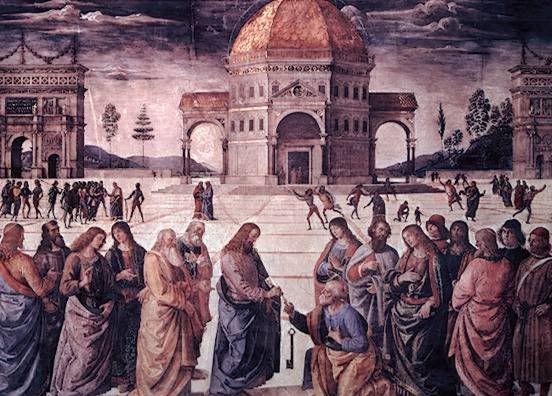
Note that the claim that the successor of Peter contains a special merit of leadership by having power from the keys handed to him through Christ cannot be an innovation from Vatican I (in the 1800s), as Luther himself is fluent with this idea. Note also his thoughts on the 95 theses--at this point his actions, whatever they were meant to produce, did not include an attack on Rome. They may have had stern words for Tetzel or some local Germans using indulgences for evil purposes, but Luther does not impute this to the Papacy.


Another statement later on in the letter shows me how the common legend that the world was in some sort of blind stupor of allegiance to the Church, with no regard to any corruption of the day, is utterly false. It is commonly said that Luther rang a clarion call against corruption, as though no other human before him had the heart and soul to cry out against corruption. On the contrary, Luther states:

None the less, however, stories about the avarice of the
priests were bruited in the taverns, and evil was spoken of
the power of the keys and of the Supreme Pontiff, and as
evidence of this, I could cite the common talk of this whole
land.

If this were the common talk of the whole land, how could there have been a general blindness to corruption? What was so special about Luther's observations?


At the end, his closing includes these words:

Wherefore, most blessed Father, I cast myself at the feet of
your Holiness, with all that I have and all that I am.
Quicken, kill, call, recall, approve, reprove, as you will. In
your voice I shall recognize the voice of Christ directing you
and speaking in you. If I have deserved death, I shall not
refuse to die.

Again, I am struck by Luther's devotion to the Pope. The key thought that I would ask you to consider and ask yourself is to read the whole letter and ask, what changed? Did he discover that the local corruption led to the root at Rome? Was he fed up with trying to invoke reforms? Was it something else?

It is clear that Luther's thoughts underwent major changes, as did the world at large. Looking more closely at his interaction with the Church leadership, and the thoughts he formulated as he broke away from submission to the Pope may unravel how, in a sense, the Christian world unraveled at the initiation of the Reformation.

Monday, July 21, 2008

The inherent chauvinism of the antipapal mindset

{This is a work in progress}

More thoughts on Saturday's debate....

I was particularly struck by the patent acceptance that the Pauline letters are silent regarding the Pope. First, there should have been a clearer insistence that that says nothing about what we as Catholics think about the Gospels' mention of Peter's role.

Secondly, the more I think about it, the more I cannot blithely accept this premise, that Paul says nothing about the Church's structure. After all, the analogy of the Church as body does include the logical conclusion that there must be a centralized head in the Church.

If one were to only read 1 Corinthians, there would be no question on the matter. Chapter 12 is the most detailed discussion of how the body should not be at war with itself, nor should members denigrate each other.

To quote:

"12The body is a unit, though it is made up of many parts; and though all its parts are many, they form one body. So it is with Christ. 13For we were all baptized by[c] one Spirit into one body—whether Jews or Greeks, slave or free—and we were all given the one Spirit to drink.14Now the body is not made up of one part but of many. 15If the foot should say, "Because I am not a hand, I do not belong to the body," it would not for that reason cease to be part of the body. 16And if the ear should say, "Because I am not an eye, I do not belong to the body," it would not for that reason cease to be part of the body. 17If the whole body were an eye, where would the sense of hearing be? If the whole body were an ear, where would the sense of smell be? 18But in fact God has arranged the parts in the body, every one of them, just as he wanted them to be. 19If they were all one part, where would the body be? 20As it is, there are many parts, but one body. 21The eye cannot say to the hand, "I don't need you!" And the head cannot say to the feet, "I don't need you!" 22On the contrary, those parts of the body that seem to be weaker are indispensable, 23and the parts that we think are less honorable we treat with special honor. And the parts that are unpresentable are treated with special modesty, 24while our presentable parts need no special treatment. But God has combined the members of the body and has given greater honor to the parts that lacked it, 25so that there should be no division in the body, but that its parts should have equal concern for each other. 26If one part suffers, every part suffers with it; if one part is honored, every part rejoices with it.27Now you are the body of Christ, and each one of you is a part of it. 28And in the church God has appointed first of all apostles, second prophets, third teachers, then workers of miracles, also those having gifts of healing, those able to help others, those with gifts of administration, and those speaking in different kinds of tongues. 29Are all apostles? Are all prophets? Are all teachers? Do all work miracles? 30Do all have gifts of healing? Do all speak in tongues[d]? Do all interpret? 31But eagerly desire[e] the greater gifts. "


Note that Paul points to hypothetical instances of members of the body disregarding each other in disunity, and in mentioning the ear, the eye, and the head, he treats all components (including the head) as though they could be guilty of such a travesty.

If we are to assume that Paul's understanding of the body is a "headless horseman" capped by Christ as head, I would argue that Paul would not have evoked such imagery. He could talk of hands denigrating feet, but not eyes denigrating hands. For that would mean that Christ is sinning by spurning the hands, etc., and how can that be the case?

So we are left with the other passages where Paul DOES describe Christ as the head. What are we to make of these words? First, the Catholic should be quick to agree that of course, He is the Head of all believers, Pope and nun alike.

Secondly, the imagery of Christ as head should never be divorced from other imagery describing our relationship with Him. Indeed, the epistle that is most forceful about Him being the head is one where one cannot surgically separate another relationship. And that epistle would have to be the letter to the Ephesians. There we find the role of Christ as head is intimately united to His position as our divine spouse.

In Ephesians 5, we find this fact clearly delineated.

To quote:
22Wives, submit to your husbands as to the Lord. 23For the husband is the head of the wife as Christ is the head of the church, his body, of which he is the Savior. 24Now as the church submits to Christ, so also wives should submit to their husbands in everything.25Husbands, love your wives, just as Christ loved the church and gave himself up for her 26to make her holy, cleansing[b] her by the washing with water through the word, 27and to present her to himself as a radiant church, without stain or wrinkle or any other blemish, but holy and blameless. 28In this same way, husbands ought to love their wives as their own bodies. He who loves his wife loves himself. 29After all, no one ever hated his own body, but he feeds and cares for it, just as Christ does the church— 30for we are members of his body. 31"For this reason a man will leave his father and mother and be united to his wife, and the two will become one flesh."[c] 32This is a profound mystery—but I am talking about Christ and the church. 33However, each one of you also must love his wife as he loves himself, and the wife must respect her husband.

There is something here that I believe our Protestant brethren our overlooking in emphasizing Christ as the Head in passages such as this.

Note what Paul says in verse 23, and consider the fact that this element of Christ as head is compared to the husband as head of the wife.
First, it does evoke the marriage imagery that is strongly described in the Apocalypse of Saint John.
Secondly, note the correlation in terms of the human existence. Do wives submit to husbands as their head in some sort of amorphous body with no mind? I'm sure some married men wish this were the case, but that would be to exist in a loveless relationship. On the contrary, there is the struggle for harmony among two wills, such that while one may be the "lord" of the other, this does not negate the head/mind/will of the bride.

As such, both the use of logic and the fuller analysis of Ephesians leads us to repudiate the visible body of Christ as lacking a visible head. It is only some chauvinistic fancy that would keep us in denial of this reality, if we really consider Paul's usage of the phrase that Christ is the head of the Church in Ephesians 5.

Sunday, July 20, 2008

The Honor of Honorius


Last night I attended a dinner party for Christians who are interested in unity. The great part about it is that these meetings not based on talking about warm and fluffy things that we have in common. Instead, there is a relatively formal debate on issues that we do not have in common. Last month I attended a debate over whether some sins were mortal and others were venial, which made for some interesting discussion.

But this one had me far more excited at the outset, for it was about a far more central difference between Protestants and Catholics--the primacy and infallibility of the Bishop of Rome.

Biblical, historical, and logical arguments were presented and at some times it was in an unbiblical, ahistorical and illogical manner, but the point is that much controversy ensued. I could say quite a bit about the strengths and weaknesses of both sides throughout this debate, but I'll stick with one criticism from the opening statement of the Anglican minister. This will allow me to stay focused (always a problem for my flitting fancy) and more importantly this criticism of his is the most important way that one would be able to formulate a criticism of Rome's claims about the papacy, in my opinion.

Before I state what was stated, let me relate the actual official statement on infallibility as Roman Catholics understand it:


891 "The Roman Pontiff, head of the college of bishops, enjoys this infallibility in virtue of his office, when, as supreme pastor and teacher of all the faithful - who confirms his brethren in the faith he proclaims by a definitive act a doctrine pertaining to faith or morals. . . . The infallibility promised to the Church is also present in the body of bishops when, together with Peter's successor, they exercise the supreme Magisterium," above all in an Ecumenical Council.418 When the Church through its supreme Magisterium proposes a doctrine "for belief as being divinely revealed,"419 and as the teaching of Christ, the definitions "must be adhered to with the obedience of faith."420 This infallibility extends as far as the deposit of divine Revelation itself.421

892 Divine assistance is also given to the successors of the apostles, teaching in communion with the successor of Peter, and, in a particular way, to the bishop of Rome, pastor of the whole Church, when, without arriving at an infallible definition and without pronouncing in a "definitive manner," they propose in the exercise of the ordinary Magisterium a teaching that leads to better understanding of Revelation in matters of faith and morals. To this ordinary teaching the faithful "are to adhere to it with religious assent" which, though distinct from the assent of faith, is nonetheless an extension of it.

Point #891 states that when the Popes make definitive acts decreeing on matters of faith or morals that he will speak without error.

Point #892 of the catechism also goes on to note that all bishops, not just the Pope, have divine assistance assuring them of being in truth, when they teach in communion with the Pope.

Let's stop and note what it does not say:

It does not confuse the office of Pope with his personal life. That a very small minority of Popes had illegitimate children, were greedy, murderous, etc., says nothing about this matter. Nor does it mean that at no point in their life will they deny Christ, as Peter himself did while Christ was on trial.

It also is not confused into thinking that the Pope will always say the best thing. Their responses to all heresies will not be the most quick-witted or even clearest.

It also narrows the scope of interest to what interests us as Christians-matters of faith and morals.

Instead the guarantee is that the successors of Peter will not teach errors. They will not fail (hence the phrase infallibility) to teach things that should be believed by Christians. Could our understanding get better as time goes on? Yes, and we should growing in the depth and clarity of our love of Our Lord. More importantly, that is exactly what the development of the councils that have occurred in history indicate.

Now, all of this preface is to make sure we are on the same page, so as to not construct any straw men in our argumentation.


Let's now dive into the actual argumentation. As I said, the key way to convince me that these claims are falsified is through historical analysis. The debater last night did invoke such historical analysis in his opening points. What era of Church history was cited? The answer: the monothelitist controversy as it took place in the 600s.


Remember, at 451 the Coptic Church began, as the idea that Christ has two natures was decreed in opposition to them. The Copts decried that as heresy, and essentially the first Protestant Reformation occurred. Their view is that Christ's human nature was subsumed by his divine, thus they are called Monophysites, meaning one nature.

In the 600's, the separation was still on the minds of many Christians (as it should be on our minds today), and some new wording that stated that Christ had just one will was being advocated by some. He may have had two natures, but he had one will. This view is called the monothelite view, as thelos means will in Greek. It was hoped that this would win back the monophysites.

From 625-638, Honorius was the Pope, the bishop of Rome. As mentioned by my Protestant brother, the sixth ecumenical council in 680 condemned this Pope over his connection to the monothelite heresy.

Now, these are surely difficult matters to delve into, but that's where things are exciting and fun.

Why was Honorius condemned? The simple answer is that he was condemned because did not condemn his monothelite contemporaries. In fact, he seems to almost be sympathetic to them when he writes to them or about them in private letters. The debate rages to this day over whether Honorius was in agreement with the monothelites or not, but the important thing to grasp is this: the debate does not rage over whether Honorius made any public statements or convened over any councils that made the error of monothelitism a binding truth for believers.

His real failure was that he did not stop monothelitism when he could have. Now first, we should note that implicitly this gives Rome's claims historical backing, as his critics are asking him to stop other bishops, which would be beyond his power if Rome's claims were false. But more importantly, Honorius did not proclaim monothelitism or approve a council that was in favor of monothelitism.

Again, his failure was a failure to stop heresy.

And so I title this post The Honor of Honorius--he failed in many senses, but he's still honorable for not publicly proclaiming heresy. I cannot say the same for myself, if you count Christians on Campus at Chino High. But I digress.

More importantly, there is a great honor in the line of Popes that one can see if one is not afraid to search the pages of history.

For last night's debate reinforced what I feared as I first embarked on this journey.

There was only an 8 minute opening statement alloted to last night's debate, and this well-studied and eloquent minister had 2000 years of history to sift and to ponder on. When his attack hinged on history, he decided to choose Honorius. Why? I would argue that it's because that's the closest one even gets to resembling a disproof of infallibility. And it's not even close. Don't you think that if there were Popes denying things like Christ's divinity, etc., that that would have been used in this debate? Instead, we're left with Honorius, who is not so dishonorable after all.

You can read more from the Catholic perspective here.

Philip Schaff's church history presents the Protestant perspective here.

Monday, June 30, 2008

June's Reads

This month was less eventful in the reading department than I had hoped because it has been so overwhelming in other departments. I suppose that's ultimately a good thing.


Here's what I managed to finish. Several other reading tasks are en route, but c'est la vie.


Autobiography-G.K. Chesterton

I love this book-great things like wine get better with age, and as Chesterton's last book prior to his departure to a better place this is no exception to that rule.
Apparently he had shunned the idea of writing an autobiography for a long time,and just weeks before dying this magnum opus by a vir magnus was completed. Just like everything else I've read by him, this work approaches the task of talking about one's self from a unique angle of looking at his world around him. Capturing his essence of being thrilled by normal existence, one gets a sense of how he thought about his own life. We leave the realm of theoretical argumentation and theoretical people in his treatises and novels, and enter the more primitive thought of one's own life.

Just as one example, he starts the book by pointing out that his very birth is a mystery-he has no memory of this undoubtable fact, and yet this lack of "proof" is supposedly the basis of doubt. With tangents that delight the mind, I have to place this book towards the top of the Chestertonian canon.


Catholic Christianity - Peter Kreeft
Former Dutch Reformed philosophy professor meets the huge volume of the Catechism-the ensuing work is a logical but warm read about how one can understand Catholicism rightly, and how one can understand it wrongly. I'm especially appreciative of how he often sets certain issues such as justification in the light of Protestantism and other philosophies of life. Appreciating the truth in beauty in all of the world without compromising his positions on Mary, the saints, etc., this makes for a great read to help one have a foundation for what it is that the Church teaches.

You can preview it here.


The Compendium of the Catechism of the Catholic Church - Pope Benedict XVI
So I mentioned above that Kreeft's work on the Catechism makes the Catechism easier to understand. Well, the compendium is what you get when Pope Benedict and friends make the 1994 Catechism easier to understand. Going back to the question and answer methodology that one sees in Catechisms such as the Westminster or Baltimore catechisms, this compendium is a succint but accurate portrayal of the tome that is the Catechism of 1994.


Fantastic Mr. Fox - Roald Dahl
What do you get when you tell me that one of my favorite directors in movies is working on an adaptation of one of my favorite novels? Me running to Barnes and Noble to add on to my collection of books! (Can you believe I have cheesier ways of conveying my thoughts on this book that I spare for the medium of the internet?)

Roald Dahl's small but exciting book about more underdogs in the world who are wronged seeking justice through mischief and ballyhoo was a great way to spend a few hours or so with my kids before I left on a trip to California. I can't wait to see
what will happen when Wes Anderson makes this movie. I'm pretty sure it will be animation, but will it be computer? Or how about a Tennenbaums-style set of sketches that come to life? As long as people who worked on Shrek stay at least 1000 miles from him at all times, I think we'll be fine. But what do I know?

Saturday, June 28, 2008

If you love me at all,

you will read this blog post by Bryan Cross, former Protestant. The way that he describes the nature of God's sovereignty and our role (or lack of a role) in salvation is essential to understanding any dialogue between Catholics and Protestants.

Tuesday, June 24, 2008

Spiritual Lessons From a Cell Phone


I write this post with an admittedly silly source of inspiration. Maybe it's better to just term this as a blog that is written for fellow users of the phone pictured above. I have had the T-Mobile Dash since October of 2006. I used to enjoy it much more, when I could access the internet for 5.99 a month through a quasi-loophole.

I also used to enjoy it much more when the battery held a charge well. After about 10 months of use, things were deteriorating. I would charge the phone for hours and it would run out of power within 1 hour. A few months later, I ordered a new battery from some ebay dealer for a few bucks. That sounded like the solution, except within 3 or 4 uses I was certain that this battery also suffered from the same problem. And so it was that for the next 5 months I would deal with a phone that would run out of batteries after about 45 minutes of talking time even if I left it in the charger all night. Of course, some nights I would be too tired, so as you can imagine, on some days I would have to charge it 3 or 4 times during the day because of a failure to do the overnight charge.

My pessimism over this phone reached its climax last week. I was on the phone near my computer and had it charging for about 4 hours that way. I left it in the charger, knowing its frailty.

It was to my great disgust that while on the phone the battery died, despite the charge going! I grabbed my wife's phone and called my friend back and continued the conversation, cursing the weakness of my phone. I was too tired to turn the phone back on so it wouldn't serve as an alarm and if anyone called me due to any possible emergencies, etc., I would be unable to answer.

The sun rose on the next morning with hope in its wings. For to my great surprise, as I turned the phone on after ~4 hrs of charging, it carried its battery throughout the day! I even neglected to charge it that night, and on the next day by late night it eventually was losing bars, but this was day TWO!

That's when I realized that my phone's charger, or the phone's design, the battery, or some odd combination of these various engineering components whose workings mystify my mind, did not operate the way I assumed that they did. It seemed like all I needed was electricity to go into the phone's battery. Whether it was on or off just couldn't matter to my "logical" mind, but reality showed the Procrustean problem I had created.
I tried charging while the phone was off for a second and a third time, and like the first time, it was as if I had a brand new phone.

So, to all T-Mobile Dash users, turn your phone off while charging, and your battery will last much longer than if you were to keep the phone on!

And so, as many of you would expect, my often silly mind saw poetry even in this cell phone lesson. For as much as my a priori considerations led me to assume that electricity would simply flow naturally into the phone regardless of whether I left it on, was text messaging, talking, taking pictures with its 1.3 megapixel camera or what have you, I did not understand this seeming flaw in the phone's design until its batteries were completely dead and I ended up charging it while off by accident.

Whether caused by a flaw or by damage, I have to pity my poor phone. And I have to learn from that phone--for my human nature is so similar to it. We seek refreshment and peace at moments in various ways; through meditation, prayer, recreation, vacation, conversation, and the like, but how many times have I glibly tried to read something or enjoy time with my family with phone calls and thoughts about e-mail/work/stress/money/the future/you name it plaguing my mind in the backdrop of that time that was set aside to recharge? It's almost as though one becomes even more tired when trying to think about one's duties while "recharging" simultaneously.

Like my phone, there have been times where my stresses from work, etc., have led me to become so frustrated mid-"relaxation" that I end up doing something foolish like get angry while I'm supposed to be having a good time with my kids, or reading an inspirational book. It seems that I am a human form of that T-mobile Dash, for good or for ill. And I think I'm not alone in being such a person who is similar to my silly, "flawed" phone. Take time to turn your "phone" of duties off when you're relaxing. Multi-tasking is for computers.