Saturday, July 25, 2009

Two quotes about the Sun

"The morbid logician seeks to make everything lucid, and succeeds in making everything mysterious. The mystic allows one thing to be mysterious, and everything else becomes lucid. The determinist makes the theory of causation quite clear, and then finds that he cannot say "if you please" to the housemaid. The Christian permits free will to remain a sacred mystery; but because of this his relations with the housemaid become of a sparkling and crystal clearness. He puts the seed of dogma in a central darkness; but it branches forth in all directions with abounding natural health. As we have taken the circle as the symbol of reason and madness, we may very well take the cross as the symbol at once of mystery and of health. Buddhism is centripetal, but Christianity is centrifugal: it breaks out. For the circle is perfect and infinite in its nature; but it is fixed for ever in its size; it can never be larger or smaller. But the cross, though it has at its heart a collision and a contradiction, can extend its four arms for ever without altering its shape. Because it has a paradox in its centre it can grow without changing. The circle returns upon itself and is bound. The cross opens its arms to the four winds; it is a signpost for free travellers.

Symbols alone are of even a cloudy value in speaking of this deep matter; and another symbol from physical nature will express sufficiently well the real place of mysticism before mankind. The one created thing which we cannot look at is the one thing in the light of which we look at everything -- Like the sun at noonday, mysticism explains everything else by the blaze of its own victorious invisibility -- Detached intellectualism is (in the exact sense of a popular phrase) all moonshine; for it is light without heat, and it is secondary light, reflected from a dead world. But the Greeks were right when they made Apollo the god both of imagination and of sanity; for he was both the patron of poetry and the patron of healing. Of necessary dogmas and a special creed I shall speak later. But that transcendentalism by which all men live has primarily much the position of the sun in the sky. We are conscious of it as of a kind of splendid confusion; it is something both shining and shapeless, at once a blaze and a blur. But the circle of the moon is as clear and unmistakable, as recurrent and inevitable, as the circle of Euclid on a blackboard. For the moon is utterly reasonable; and the moon is the mother of lunatics and has given to them all her name." - G.K. Chesterton


"How can a soul so imperfect as mine aspire to the plenitude of
Love? What is the key of this mystery? O my only Friend, why dost
Thou not reserve these infinite longings to lofty souls, to the
eagles that soar in the heights? Alas! I am but a poor little
unfledged bird. I am not an eagle, I have but the eagle's eyes and
heart! Yet, notwithstanding my exceeding littleless, I dare to
gaze upon the Divine Sun of Love, and I burn to dart upwards unto
Him! I would fly, I would imitate the eagles; but all that I can
do is to lift up my little wings--it is beyond my feeble power to
soar. What is to become of me? Must I die of sorrow because of my
helplessness? Oh, no! I will not even grieve. With daring
self-abandonment there will I remain until death, my gaze fixed
upon that Divine Sun. Nothing shall affright me, nor wind nor
rain. And should impenetrable clouds conceal the Orb of Love, and
should I seem to believe that beyond this life there is darkness
only, that would be the hour of perfect joy, the hour in which to
push my confidence to its uttermost bounds. I should not dare to
detach my gaze, well knowing that beyond the dark clouds the sweet
Sun still shines.

So far, O my God, I understand Thy Love for me. But Thou knowest
how often I forget this, my only care. I stray from Thy side, and
my scarcely fledged wings become draggled in the muddy pools of
earth; then I lament "like a young swallow,"[19] and my lament
tells Thee all, and I remember, O Infinite Mercy! that "Thou didst
not come to call the just, but sinners."[20]

Yet shouldst Thou still be deaf to the plaintive cries of Thy
feeble creature, shouldst Thou still be veiled, then I am content
to remain benumbed with cold, my wings bedraggled, and once more I
rejoice in this well-deserved suffering.

O Sun, my only Love, I am happy to feel myself so small, so frail
in Thy sunshine, and I am in peace . . . I know that all the
eagles of Thy Celestial Court have pity on me, they guard and
defend me, they put to flight the vultures--the demons that fain
would devour me. I fear them not, these demons, I am not destined
to be their prey, but the prey of the Divine Eagle.

O Eternal Word! O my Saviour! Thou art the Divine Eagle Whom I
love--Who lurest me. Thou Who, descending to this land of exile,
didst will to suffer and to die, in order to bear away the souls
of men and plunge them into the very heart of the Blessed
Trinity--Love's Eternal Home! Thou Who, reascending into
inaccessible light, dost still remain concealed here in our vale
of tears under the snow-white semblance of the Host, and this, to
nourish me with Thine own substance! O Jesus! forgive me if I tell
Thee that Thy Love reacheth even unto folly. And in face of this
folly, what wilt Thou, but that my heart leap up to Thee? How
could my trust have any limits?" - St. Therese of Lisieux

Thursday, July 23, 2009

On Perspicuity and the Inclusion of Commentaries

My latest contribution to Called to Communion can be found at this URL.

Have a nice day!

Friday, July 17, 2009

The Joy of Drinking

Read it here.

This thought is especially interesting.

"Good drinking is not a flight from reality–the good drinker is acutely aware of the realities surrounding him. Indeed, this awareness is the key to understanding good drinking. Although there are periodic exceptions, life is generally good because earthly existence is a gift of God. This fact is clouded by the grinding troubles of everyday life. But most of these troubles are not troubles at all–they are merely worries stemming from ambitions, ambitions triggered by the self’s pursuit of gratification, a pursuit that causes us to feel harried throughout the workday, to struggle to earn more money than we really need, to dwell on petty things that are beneath our status as creatures made in God’s image."

Saturday, June 20, 2009

I just blogged Two Hundred and Thirty-eight Times

How, do you ask? I took some older posts which were previously on "The Mathoms" and the now less than apt blog entitled "Contrarian Presbyterian" and restored them here. Some may be ones which make me blush, but I realize they were written by me and there were some important things said there. So if you feel like going back in time/taking a trip down odd memory lane, you know where to go....

Monday, June 8, 2009

scientific proof of God


People request scientific proof of God, and yet we never ask for scientific proof for love.

He who calls Himself love should be viewed with the same straining (or unstraining, longing, loving) gaze that would mock the call for scientific proof of such postulates and hypotheses such as the one which posits that my daughter is precious to me. If God is love and love is not proven scientifically, something is seriously awry when we try to offer scientific proof of God. The same is true for the skeptic, who wants to show God does not exist through the same faulty and inappropriate tools.

And yet so many defenders of God and His detractors hold up the rubric of proving God by empiricism and quantification, and they wonder why they end up with dust in their eyes and friendships torn apart as a result. More confusion than light comes from these types of arguments.

In fact, I take it back---it's not that we never ask for scientific proof for love. If only that were the case. Serious problems arise all the time, and if you look at divorce rates it seems they are growing exponentially. They come about when we ask for that scientific proof in the realm of love. Love is not quantified. Further, our sample size is construed in a biased fashion. We think in such a short termed manner that we end up denying love's truth in places where love is truly there. The short term drowns the more permanent messages. We lose context.

We are all too often operating as though science were the proof of love (and everything). And when we come home to the messy home, or we see our love in their tiredness utter a rash word, our microscopic view of the trees loses the forest that may not be as rotten as the stump that crossed our path at this point in our sojourn.

We must put an end to all scientific quests for love, and begin the relational experience of the people who love us. Let's not learn about how much someone does or does not love us. Let's love and be loved. There are Three who come to mind as a good starting point. But yes, I know, so many are afraid of that journey. Begin where you can, and do not hesitate to progress as mercy opens His doors your way, whether through Himself or in any corner of His amazing world of love and hospitality.

Friday, May 29, 2009

Trust This Church?


From the Introduction to a book entitled Light and Shadows: Church History amid Faith, Fact and Legend by Father Walter Brandmüller (I found it here), we have this question about trusting the Church.


To me this is the quintessential question---if the Church that was founded by the Apostles and their successors was given a gift whereby her fidelity was maintained, nothing can really stand in the way from joining her. But that is a big "if", and people have big questions. It sounds like Father Brandmüller makes some interesting arguments that I hope and pray will go towards convincing people that this act of trust is worth making.

This introduction makes me wish I could afford another book to my collection--then again, my birthday is in ~3 months....hm.....


Occasionally the Church is compared with Noah's ark: only his sons and daughters, only those animals that Noah took with him into the ark were saved from the great flood. In a similar way, the Church is supposed to be man's only rescue from the final catastrophe.

When discussion turns to the Last Things, to man's eternal fate, then the question assumes the utmost urgency: To whom can he entrust his eternal fate and himself? What can he rely on in life and death? Now, since the Church makes the exclusive claim to be the saving ark, this claim must be so solidly established that it does not mean a leap into uncertainty when man puts his trust in this ark.

Questions About Questions

To many of our contemporaries, such trust in the Church appears to be nothing less than an unreasonable demand upon sound common sense. Aren't there countless facts (the objection goes) that demolish the credibility of the Church?

Many people have read the numerous books or seen the television programs that deal with the subject of the Qumran community and seem to offer proof that the beginnings of Jesus of Nazareth and of Christianity ought to be portrayed in a completely different way from what is recorded in the Gospels and the rest of the New Testament. Many have also seen the earthenware receptacle containing human remains that was found in Jerusalem, on which the names Joseph, Mary and Jesus were inscribed. Isn't this compelling evidence that Jesus did not rise bodily from the dead and that Mary was not taken body and soul into heaven? With that, however, the foundations of the Christian faith crumble into dust and ashes! Many people today suspect that this is so.

Furthermore, the Church—as they say—through clumsy errors made by her official teaching authority on numerous occasions, has repudiated her claim to hold the truth infallibly. Let us listen to Hans Küng, who lists the "classic errors of the Church's Magisterium, most of which have been admitted". First he mentions the "excommunication of the Ecumenical Patriarch of Constantinople, Photius, and of the Greek [Byzantine] Church, which formalized the soon-to-be millennial schism with the Eastern Church". Then Küng adduces "the prohibition against charging interest [on loans] at the beginning of the modern era, whereby the Church's Magisterium changed its opinion much too late, after various compromises". Then (what else could you expect?) he also cites the trial of Galileo in 1616 or else in 1633 and other things of this sort. The most recent major error of the Magisterium, in his view, is its rejection of artificial contraception.

Others before and after him have pilloried the Church on account of the Crusades, the Inquisition and the witch trials, and anyone who is still not satisfied is referred to the financial scandal of the Vatican Bank and the murder conspiracy against Pope John Paul I, who was so likeable: Mafia in the Vatican, at the heart of the Church. From another corner the cry is that a power-hungry clique of Freemasons already replaced Paul VI with a double whom they could control and that the Lodge in general seized power in the Vatican long ago—and so on. Therefore, who can still trust such a Church?

If you are really going to ask the critical question about reliability, however, then direct it not only at the Church but also at the objections that are raised against her.

Justified Criticism?

The Qumran Theme

The most popular books about Qumran, The Dead Sea Scrolls Deception by Baigent and Leigh, and Jesus und die Urchristen [Jesus and the Early Christians] by Eisenmann, as well as other comparable publications on this topic, have been exposed by serious researchers as clumsy concoctions. The books are partly the result of scientific incompetence; to some extent they are based on deliberate, malicious falsification of the facts. It is precisely the archaeological findings at Qumran that, quite to the contrary. shed an extremely interesting light on the New Testament and even clear up riddles. And as for the ossuary with the names of Joseph, Mary and Jesus [Joshua], which actually comes from Jerusalem and dates back to the time of Jesus, the names mean nothing at all, when you consider that they were as common and therefore as insignificant as the names Miller, Fields and Smith would be today.

Similarly, with regard to Hans Küng's "errors" of the Church's Magisterium, we are dealing more with the errors of Hans Küng than with those of the Church. First of all, in page after page, he confuses Patriarch Photius with Patriarch Michael Cerullarius. Then Küng fails to mention that Photius was excommunicated because he had become Patriarch in an unlawful manner and furthermore had accused Rome of heresy and had tried to depose Pope Nicholas I by means of a manipulated synod. Depending on how one views the particular historical circumstances of this case, one could possibly speak about a wrong decision in ecclesiastical politics or an unjust excommunication, but never about an error of the Church's Magisterium.

The same is true for the prohibition against lending at interest and its gradual abolition by the Church. This prohibition against charging interest was based on the Old Testament and had been confirmed by popes and councils. Why this was so becomes clear when you consider that in antiquity and in the medieval world, charging interest was most often identical to usury. Lending at interest lost this sinful character, however, with the transformation of commercial structures in the late Middle Ages. Thus the reason for the prohibition against charging interest became moot over the course of time, and from then on the only concern was with the question of determining the just rate of interest. The general prohibition had thereby become null and void. So where in all this is there an error of the Church's Magisterium?

The condemnation of Galileo's teaching about the fixed position of the sun and the movement of the earth, which is also so often described as an error of the Church's Magisterium, proves upon closer inspection to have been justified at the time. With the scientific methods at his disposal, Galileo could not offer a proof that would convince the specialists either of his day or of ours that that is really the case, nor could he explain, before the discovery of gravity by Isaac Newton, how the earth could possibly revolve at breakneck speed around the sun and around its own axis while at the same time nothing of the sort is perceived by us, since everything on earth stands firm and secure instead of being tossed about in a tumultuous whirl. Most importantly, though, the whole legal proceeding against Copernicus and Galileo resulted in not one single magisterial statement that could have been described as a dogma and on that account would have been irrevocable. In this case, too, the critics fail to take into consideration the many events and facts in intellectual, cultural and scientific history that explain this decision. Furthermore, the most recent scientific findings vindicate the Church of 1633.

A comparably nuanced, careful and comprehensive approach should be taken to the problems connected with the touchy subjects of the Crusades, the Inquisition and the witch trials. In light of recent findings and the latest research, these subjects prove to be many-layered and much more complicated than the superficial observations oft hose who look at them as a source of ammunition against the Church. Moreover, anyone who has even the foggiest notion of the complexity of Financial-political activities and their worldwide interconnections and knows, furthermore, what sort of possibilities they offer for manipulation, will assume that the aforementioned Vatican financial scandal resulted from excessive gullibility or perhaps incompetence or even frivolity in financial matters on the part of the ecclesiastical authorities rather than from criminal intrigues.

As for an opinion of Yallop's book, In God's Name, which maintains that John Paul I was murdered, it is enough to read the first thirty pages in order to pass judgment. On these pages there is talk about the popes of the nineteenth century, and so much of it is false that it is hard to imagine that the author used even an encyclopedia—for that would have sufficed to prevent the numerous errors. If Yallop does not report correctly what everyone can easily find out, how are we supposed to be able to believe him when he cites conversations and events for which, by the very nature of the matter, there can be no witnesses except those who were supposedly involved? No doubt, nothing more should be said about the double of Paul VI and other such luxuriant outgrowths of overheated imaginations.

All these things and many others besides are alleged in order to shake confidence in the Church. As we have shown in these all-too-brief remarks, however, in all these cases that supposedly vitiate the Church, historical and theological knowledge about the subject is enough to prove that such accusations are groundless.

But What About the Moral Failings?

One can with good reason retort that the most extensive knowledge about a subject of this kind will not suffice to excuse the religious and moral failings of important members of the Church throughout the centuries and in every locality, down to the papal adulterer Alexander VI. But then the question arises, on what do we actually base the trust that we place in the Church?

The real basis for our trust can never be a splendid spiritual, moral and religious manifestation of the Church in this world. This has existed and indeed does exist always and everywhere—but one likewise finds always and everywhere the much more conspicuous opposite. Thus all romanticism about the early Church, a romanticism that imagines it sees in the first generations of Christians nothing but holiness and greatness, necessarily runs aground on the hard facts: the Christian married couple Ananias and Sapphira tried to defraud the Apostle Peter; in Paul's congregation at Corinth, there was a case of incest and rebellion against the Apostle; in Philippi, Saint Paul's committed female co-workers Euodia and Symyche quarreled with each other so much that Paul had to give them a serious warning. Indeed, Paul himself parted with Mark and Barnabas during one of his journeys due to differences of opinion that were evidently insuperable. Finally, as early as the year 70, according to the latest research, there was an uprising in Corinth against the priests, such that the Bishop of Rome had to intervene forcefully.

Thus the Church has never had that spotlessly radiant appearance that she ought to have. So it is no wonder, either, that those who believed that they were especially devout were scandalized again and again by this and founded their own "church of the blameless". In contrast, the Church has always shown herself to be a great realist who has always and everywhere reckoned with the failure of her members. Not for nothing did the Lord Jesus himself, who searches and knows the depths of the human heart, institute the sacrament for the forgiveness of sins.

It cannot be said, either, that the shepherds and members of the Church have always and everywhere reacted correctly to the chal1enges of history. On the contrary, many mistakes have been made that subsequently became notorious. For example, was not it disastrous that Pope Clement V allowed himself to be intimidated by the demands of the French king Philip and abandoned the order of Knights Templar, who as a whole were certainly innocent, to a downfall that was in large pare bloody? Entire episcopates—today we would say bishops' conferences—fell into heresy during the Arian crisis of the fourth and fifth centuries. In the sixteenth century the bishops of England, with the exception of Saint John Fisher, followed King Henry Vlll into schism our of weakness and cowardice, and similarly the French episcopate, during the conflict over the freedom of the Church from the state, stood beside Louis XIV against the pope. For almost two centuries the French bishops promoted the heresy of Jansenism. There were not many exceptions, And how did the German bishops conduct themselves during the eleventh- and twelfth-century Investiture Controversy? In 1080 a majority of the German bishops, under the influence of Emperor Henry IV, made an attempt at a synod in Brixen to depose Pope Gregory VII and to elect an antipope. Those German bishops who found themselves confronted with the religious division of the sixteenth century no doubt failed in large measure, too.

Truly, all of this does not make for glorious pages in the ecclesiastical chronicles. In the end, therefore, we cannot place our trust in the wisdom and power of the shepherds, either. No promise was ever made to the Church that her shepherds and her faithful would be irreproachable or capable. What her Founder, the God-man Jesus Christ, did guarantee, nevertheless , is that she will continue unshakably and stand fast immovably in the truth until his return at the end of time. This means that the Church can never proclaim an error in matters of faith whenever she speaks in a form that is ultimately binding; that her sacraments always produce their characteristic effects of grace, provided that they are administered according to the Church's directions; and that her hierarchical-sacramental structure comprising the ministries of primacy, episcopacy and priesthood will always be maintain ed intact. Precisely thereby it is guaranteed that the graces of redemption will continue to be available to the people of all generations, until the Lord comes again.

Thursday, May 28, 2009

the abstract and concrete can do the same

David Bazan is one of my favorite songwriters from this generation. This meaning, the one where I found myself living some 31 years ago (or so).

Probably my favorite Bazan song of all time is this one, which as I mentioned on a previous post, he apparently won't play any more.


The Secret of the Easy Yoke has such simple words that were so true to life of my experience as an evangelical, and they have their own resonance with my experience as a Reformed Presbyterian and my current experience as a Catholic.

i could hear the church bells ringing
they pealed aloud your praise
the members faces were smiling
with their hands out stretched to shake
it's true they did not move me
my heart was hard and tired
their perfect fire annoyed me
i could not find you anywhere

could someone please tell me the story
of sinners ransomed from the fall
i still have never seen you
and some days i don't love you at all

the devoted were wearing bracelets
to remind them why they came
some concrete motivation
when the abstract could not do the same
but if all that's left is duty
i'm falling on my sword
at least then i would not serve
an unseen distant lord

if this is only a test
i hope that i'm passing
cause i'm losing steam
and i still want to trust you

peace be still


For the past several months, I have thought a lot about Bazan's sojourns in doubt, and am eagerly anticipating his next full length album, which I have had the privilege to see performed on two occasions in small house gatherings.

And while his newer songs have interesting thoughts about doubt and damnation, I keep coming back to this song which is now over 10 years old.

One line reverberates in my skull, and it is this:

"the devoted were wearing bracelets to remind them why they came,
some concrete motivation when the abstract could not do the same,
but if all that's left is duty i'm falling on my sword,
at least then i would not serve an unseen distant lord."

The more I think about it the more I am convinced that part of Bazan's problem (and the problem that we all face) with keeping his faith secure is this mentality that the concrete and the abstract are at war with one another.

We are all concrete people with abstract convictions, not mere ideas or concepts of people. Who are we to shun a world where one's abstract convictions are bolstered by one's concrete experience? And who would we be to have our concrete duties and actions regulated by the abstract?

To deny this interweaving relationship is to deny our own complexity.

Now, whether bracelets are the best form of concrete motivation or not, that is another question for another time....

Thursday, May 21, 2009

on plastic dolls and plastic hammers


We have all seen or experienced that familiar scene--a young child acting as though they were all grown up.

This image of our humanity's finitude in light of the ideal that is divinity Himself is especially poignant in my own life for many reasons, but chief on my mind at the moment is watching my beloved daughter. It is absolutely jaw-dropping, inspiring stuff to see a baby girl of almost thirteen months adopt the role of mother with her doll with the zeal of an actual mother. And it reminds me of my feebleness as one who is "actually" a father. I am humbled and in awe at the fact that I have been given these children who are mine to raise, and I am reminded that at the end of the day, all of our efforts to be good people are really approximations of who God is. And despite our coming short, I am prone to thinking that God looks at us, just as I look at my daughter with her doll, or my sons with their tools. Is their actual child raising or craftmanship amazing? No. But their hearts, oh their precious hearts. They are attuned to their calling at life to be someone who makes something of this life.

I know that our Blessed Lord must look at us and see all of the ways that we have made a mess and confusion of this life that we live, but if we are carrying our own dolls and hammers about with the joy, faith, hope, and love of those children, we'll end up all right in the end. At least, that's my hope for us all....

Monday, May 11, 2009

Friday, May 8, 2009

The Grandeur of Covenant Theology

Another post on the same site, this one was much more work for me....read it here.

Thursday, May 7, 2009

Looking Images in the Eye

New blog post by yours truly here.

Check it, por favor.

Tuesday, May 5, 2009

faith vs. ?

Many would set Rome apart from the other Western Christians by saying it's a matter of faith vs. works.

Well, yes and no.

In meditating on many writers and philosophers and average Joe's, I've come to see that it is not about "works".

It's more a matter of saying that we are saved by faith, hope and love.

And when the world is distilled to such a simple view where prayers are not counted or tallied, and instead love and hope are joined hand in hand with faith, I cannot help but ask......how can you object to such a view of the world?

It's a view where these words make sense:

For in Christ Jesus neither circumcision nor uncircumcision counts for anything, but only faith working through love. Galatians 5:6


The same could be said about these words, which look at the world from the "glass is half empty" viewpoint:

....if I have all faith, so as to remove mountains, but have not love, I am nothing. 1 Corinthians 13:2b


Saturday, May 2, 2009

On the incarnation of the Word


From a discourse by Saint Athanasius (295-373 AD), bishop

The Word of God, incorporeal, incorruptible and immaterial, entered our world. Yet it was not as if he had been remote from it up to that time. For there is no part of the world that was ever without his presence; together with his Father, he continually filled all things and places.
Out of his loving-kindness for us he came to us, and we see this in the way he revealed himself openly to us. Taking pity on mankind’s weakness, and moved by our corruption, he could not stand aside and see death have the mastery over us; he did not want creation to perish and his Father’s work in fashioning man to be in vain. He therefore took to himself a body, no different from our own, for he did not wish simply to be in a body or only to be seen.
If he had wanted simply to be seen, he could indeed have taken another, and nobler, body. Instead, he took our body in its reality.
Within the Virgin he built himself a temple, that is, a body; he made it his own instrument in which to dwell and to reveal himself. In this way he received from mankind a body like our own, and, since all were subject to the corruption of death, he delivered this body over to death for all, and with supreme love offered it to the Father. He did so to destroy the law of corruption passed against all men, since all died in him. The law, which had spent its force on the body of the Lord, could no longer have any power over his fellowmen. Moreover, this was the way in which the Word was to restore mankind to immortality, after it had fallen into corruption, and summon it back from death to life. He utterly destroyed the power death had against mankind – as fire consumes chaff – by means of the body he had taken and the grace of the resurrection.
This is the reason why the Word assumed a body that could die, so that this body, sharing in the Word who is above all, might satisfy death’s requirement in place of all. Because of the Word dwelling in that body, it would remain incorruptible, and all would be freed for ever from corruption by the grace of the resurrection.
In death the Word made a spotless sacrifice and oblation of the body he had taken. by dying for others, he immediately banished death for all mankind.
In this way the Word of God, who is above all, dedicated and offered his temple, the instrument that was his body, for us all, as he said, and so paid by his own death the debt that was owed. The immortal Son of God, united with all men by likeness of nature, thus fulfilled all justice in restoring mankind to immortality by the promise of the resurrection.
The corruption of death no longer holds any power over mankind, thanks to the Word, who has come to dwell among them through his one body.

Thursday, April 30, 2009

Conscious Immolation-St. Gianna Beretta Molla

Pope John Paul II wrote this in 1994, on the date of this saint's canonization:
Gianna Berretta Molla was a simple, but more than ever, significant messenger of divine love. In a letter to her future husband a few days before their marriage, she wrote: "Love is the most beautiful sentiment the Lord has put into the soul of men and women".

Following the example of Christ, who "having loved his own... loved them to the end" (Jn 13: 1), this holy mother of a family remained heroically faithful to the commitment she made on the day of her marriage. The extreme sacrifice she sealed with her life testifies that only those who have the courage to give of themselves totally to God and to others are able to fulfil themselves.

Through the example of Gianna Beretta Molla, may our age rediscover the pure, chaste and fruitful beauty of conjugal love, lived as a response to the divine call!


From the Vatican's biography, you can read of her life.


Gianna Beretta was born in Magenta (Milan) October 4, 1922. Already as a youth she willingly accepted the gift of faith and the clearly Christian education that she received from her excellent parents. As a result, she experienced life as a marvellous gift from God, had a strong faith in Providence and was convinced of the necessity and effectiveness of prayer.

She diligently dedicated herself to studies during the years of her secondary and university education, while, at the same time, applying her faith through generous apostolic service among the youth of Catholic Action and charitable work among the elderly and needy as a member of the St. Vincent de Paul Society. After earning degrees in Medicine and Surgery from the University of Pavia in 1949, she opened a medical clinic in Mesero (near Magenta) in 1950. She specialized in Pediatrics at the University of Milan in 1952 and there after gave special attention to mothers, babies, the elderly and poor.

While working in the field of medicine-which she considered a “mission” and practiced as such-she increased her generous service to Catholic Action, especially among the “very young” and, at the same time, expressed her joie de vivre and love of creation through skiing and mountaineering. Through her prayers and those of others, she reflected upon her vocation, which she also considered a gift from God. Having chosen the vocation of marriage, she embraced it with complete enthusiasm and wholly dedicated herself “to forming a truly Christian family”.

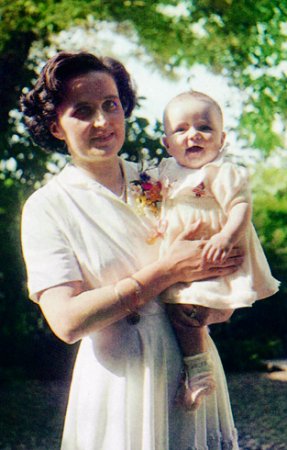
She became engaged to Pietro Molla and was radiant with joy and happiness during the time of their engagement, for which she thanked and praised the Lord. They were married on September 24, 1955, in the Basilica of St. Martin in Magenta, and she became a happy wife. In November 1956, to her great joy, she became the mother of Pierluigi, in December 1957 of Mariolina; in July 1959 of Laura. With simplicity and equilibrium she harmonized the demands of mother, wife, doctor and her passion for life.

In September 1961 towards the end of the second month of pregnancy, she was touched by suffering and the mystery of pain; she had developed a fibroma in her uterus. Before the required surgical operation, and conscious of the risk that her continued pregnancy brought, she pleaded with the surgeon to save the life of the child she was carrying, and entrusted herself to prayer and Providence. The life was saved, for which she thanked the Lord. She spent the seven months remaining until the birth of the child in incomparable strength of spirit and unrelenting dedication to her tasks as mother and doctor. She worried that the baby in her womb might be born in pain, and she asked God to prevent that.

A few days before the child was due, although trusting as always in Providence, she was ready to give her life in order to save that of her child: “If you must decided between me and the child, do not hesitate: choose the child - I insist on it. Save him”. On the morning of April 21, 1962, Gianna Emanuela was born. Despite all efforts and treatments to save both of them, on the morning of April 28, amid unspeakable pain and after repeated exclamations of “Jesus, I love you. Jesus, I love you», the mother died. She was 39 years old. Her funeral was an occasion of profound grief, faith and prayer. The Servant of God lies in the cemetery of Mesero (4 km from Magenta).

“Conscious immolation», was the phrase used by Pope Paul VI to define the act of Blessed Gianna, remembering her at the Sunday Angelus of September 23, 1973, as: “A young mother from the diocese of Milan, who, to give life to her daughter, sacrificed her own, with conscious immolation”. The Holy Father in these words clearly refers to Christ on Calvary and in the Eucharist.

Gianna was beatified by Pope John Paul II on April 24, 1994, during the international Year of the Family.


How many of us would react to the gift of life with this way? Would we rather save our own life than the life of others? I am extending this meditation far beyond the matter of abortion vs. choosing life. It seems far broader.

I wonder if some would consider the Church's praise of her medically foolish. Whether that is the case or not, I can see the fruits of the alternative view. They are all around me-or rather, they are all not around me.


Pray for us, St. Gianna Beretta Molla. Help us to love life as you did.


Saturday, April 25, 2009

the miracle of san juan deane

Roughly one month ago, some friends accompanied my family to the Mission at San Juan Capistrano. There was to be a festival in honor of Italian culture (as San Juan Capistrano was actually named Giovanni Capestrano) and also in honor of the famed swallows and their return to the mission.

There are many things I could say, but for now I'll say that I'm not going to share any photos that we actually took. The one thing from the Mission that I'll share here is a picture of the Fr. Serra chapel. I love it for its European style-you could have told me we were in a time machine and living back during the time when California was a part of Nueva España.


Despite enjoying the chapel's beauty, the real occasion in my book was to see the return of the swallows.

I think one of my companions was especially in agreement with me that when we realized that the swallows don't really come back to the Mission anymore (not on time, or this year at least), that this was a huge disappointment. It was supposed to be like the "Old Faithful" of bird migration, and yet they didn't show!

It was a few weeks later when, on the way to an early morning teleconference, I was about to leave when I realized that something was going on outside of our apartment. Birds were circling around the roof. Looking up, I realized that the top of the building on the underside was hosting many birds. There was no nest at the time, but what is most important is that the ornithologist in me realized that with those curved wings, these were swallows!

I called my fellow doubter and told him that swallows appeared to be nesting at my home. However, whenever I would look again they weren't around. As time passed, I started to doubt whether the swallows were nesting--maybe they just took a pit stop at our place.

It then dawned on me that dawn (and dusk) were the key. They fly around a lot during that time of day, and my schedule was such that I was too late in the morning or the evening for their special dance. The other thing that the passage of time has shown was that they were nesting, it's just that their special mud nests take time. In this picture, you can see how on one side the nest is quite substantial, and the other is growing. Further, one can see how much work they got done that day, as the wetter mud is darker and shows a nice little ring of their labor. I love saying hello to these little friends.

My next goal will be to walk around the complex and see how many other buildings have swallow nests. If this is the only one, this may be the miracle of Juan Deane.....

Thursday, April 23, 2009

water and spirit? quid est veritas?

1
Now there was a Pharisee named Nicodemus, a ruler of the Jews.
2
He came to Jesus at night and said to him, "Rabbi, we know that you are a teacher who has come from God, for no one can do these signs that you are doing unless God is with him."
3
Jesus answered and said to him, "Amen, amen, I say to you, no one can see the kingdom of God without being born from above."
4
Nicodemus said to him, "How can a person once grown old be born again? Surely he cannot reenter his mother's womb and be born again, can he?"
5
Jesus answered, "Amen, amen, I say to you, no one can enter the kingdom of God without being born of water and Spirit.
6
What is born of flesh is flesh and what is born of spirit is spirit.
7
Do not be amazed that I told you, 'You must be born from above.'
8
The wind blows where it wills, and you can hear the sound it makes, but you do not know where it comes from or where it goes; so it is with everyone who is born of the Spirit."
9
Nicodemus answered and said to him, "How can this happen?"
10
Jesus answered and said to him, "You are the teacher of Israel and you do not understand this?
11
Amen, amen, I say to you, we speak of what we know and we testify to what we have seen, but you people do not accept our testimony.
12
If I tell you about earthly things and you do not believe, how will you believe if I tell you about heavenly things?
13
No one has gone up to heaven except the one who has come down from heaven, the Son of Man.
14
And just as Moses lifted up the serpent in the desert, so must the Son of Man be lifted up,
15
so that everyone who believes in him may have eternal life."
16
For God so loved the world that he gave his only Son, so that everyone who believes in him might not perish but might have eternal life.
17
For God did not send his Son into the world to condemn the world, but that the world might be saved through him.
18
Whoever believes in him will not be condemned, but whoever does not believe has already been condemned, because he has not believed in the name of the only Son of God.
19
And this is the verdict, that the light came into the world, but people preferred darkness to light, because their works were evil.
20
For everyone who does wicked things hates the light and does not come toward the light, so that his works might not be exposed.
21
But whoever lives the truth comes to the light, so that his works may be clearly seen as done in God.
22
After this, Jesus and his disciples went into the region of Judea, where he spent some time with them baptizing.
23
John was also baptizing in Aenon near Salim, because there was an abundance of water there, and people came to be baptized,
24
for John had not yet been imprisoned.
25
Now a dispute arose between the disciples of John and a Jew about ceremonial washings.
26
So they came to John and said to him, "Rabbi, the one who was with you across the Jordan, to whom you testified, here he is baptizing and everyone is coming to him."
27
John answered and said, "No one can receive anything except what has been given him from heaven.
28
You yourselves can testify that I said (that) I am not the Messiah, but that I was sent before him.
29
The one who has the bride is the bridegroom; the best man, who stands and listens for him, rejoices greatly at the bridegroom's voice. So this joy of mine has been made complete.
30
He must increase; I must decrease."
31
The one who comes from above is above all. The one who is of the earth is earthly and speaks of earthly things. But the one who comes from heaven (is above all).
32
He testifies to what he has seen and heard, but no one accepts his testimony.
33
Whoever does accept his testimony certifies that God is trustworthy.
34
For the one whom God sent speaks the words of God. He does not ration his gift of the Spirit.
35
The Father loves the Son and has given everything over to him.
36
Whoever believes in the Son has eternal life, but whoever disobeys the Son will not see life, but the wrath of God remains upon him.

memories of poetry in the 90's.....


In winter when the air gets cold
And breathing causes white ghosts to appear

They light up the city with Christmas trees
And strings that hang across the street
From telephone pole to telephone pole

So that when I'm driving home at night
Tired frustrated and pinned down by spite
I'm reminded of your love
Unlike these things will never change
Or fade or pass away

Wednesday, April 22, 2009

Protestantism is dangerous?


From http://insightscoop.typepad.com/2004/2009/04/protestantism-is-dangerous-.html

"Protestantism is dangerous. ..."

It is an explosive and ultimately uncontrollable force that can destabilize and undermine church and government. It can reject time-honored truths, traditions and institutions—including its own—and posit new ones in their place, only to repeat this process again and again. Protestantism is infinitely restless, constantly moving in many divergent directions at the same time. Like evolution, it possesses astonishing power to create highly adaptive religious organisms and equally astonishing power to destroy them if they fail to develop appropriately.

No, that isn't from a Catholic apologist; it is from Ronald K. Rittgers, who teaches German Reformation studies at Valparaiso University in Indiana, in his review, for The Christian Century, of Alister McGrath's recently published Christianity's Dangerous Idea: The Protestant Revolution—A History from the Sixteenth Century to the Twenty-First:

This is how Alister McGrath, professor of historical theology at the Univer sity of Oxford, depicts Protes tantism in Christianity's Dangerous Idea. Why is Protestantism so dangerous? Because it is based on a dangerous idea: that the Bible is the main source of authority for the Christian religion and that all Christians have the right to interpret it for themselves. This conviction is the source not only of Protestantism's vitality and flexibility, but also of its lack of fixedness and its innate tendency toward schism. McGrath makes much of the former without losing sight of the latter.


McGrath also stresses that early Protestantism was not a single, unified, coherent movement; it was a movement of movements that was characterized by conflict, tension and flux from the start. The only thing the early Protestants shared was the dangerous idea. And they quickly learned just how dangerous it could be when they found themselves unable to reach consensus on important matters of doctrine. After examining the failure of Luther, Zwingli and others to resolve their differences on the Lord's Supper, McGrath observes, "We see here the fundamental difficulty that the Reformation faced: the absence of any authoritative interpreter of scripture that could give rulings on contested matters of biblical interpretation."

And? What then?

Protestants attempted to remedy this problem by constructing various interpretative authorities—Luther's catechisms, Calvin's Institutes, the marginalia of the Geneva Bible—but none could furnish truth claims that were accepted by all Protestants. Whatever external coherence early Protestants had was largely dependent on the presence of a defining other—Catholics in the early modern period and secularists in the later modern era. This need for an external source of self-definition became part of the core of Protestantism.

Which finally leads to this:

It is true that the defining Pro testant idea is dangerous. But one can question whether McGrath has plumbed the full depths of its threat. The real danger is that when confronted with the competing Protestant truth claims about crucial matters of faith—including those that touch on salvation—theologically reflective Protestants may lose confidence in their ability to interpret or even trust scripture, and thus their ability to know God. Sebastian Franck saw this danger already in the 16th century and thus opted for a Spiritualism that sought to transcend all dogmatic claims about God—except Spiritualist ones, of course. Fortunately, most Protestants do not experience this complete loss of epistemic confidence, at least not on a permanent basis, which may be the reason McGrath avoids discussing the risk.

Some people view the Bible largely as a human artifact that contains important human wisdom about God but needs to be supplemented and corrected by more modern sources of wisdom. McGrath makes clear that such liberal Protestants are a small minority in the Protestant world. It seems that most—including McGrath, perhaps—continue to believe in the perspicuity of scripture. It is remarkable, after all, that the vast majority of Protestants agree with one another and with most non-Protestant Christians about the essentials of salvation—that is, that it comes only through Christ and requires grace and faith. But one wonders if this surprising agreement is not owing to another yet dangerous idea that was present in the primordial materials from which Protestantism burst forth and that thus became part of its genetic code: the importance of clinging to the ancient rule of faith. If this is the case, Catholicism did not simply motivate the construction of a unified Protestant front; it also provided Protestants with a certain immunity against the most destructive possibilities of their core idea.

That is part of the argument, interestingly enough, made by Fr. Louis Bouyer (a former Lutheran pastor), in his important book, The Spirit and Forms of Protestantism. In reviewing that book, Mark Brumley wrote:

The negative principles of the Reformation necessarily led the Catholic Church to reject the movement–though not, in fact, its fundamental positive principles, which were essentially Catholic. Eventually, argues Bouyer, through a complex historical process, these negative elements ate away at the positive principles as well. The result was liberal Protestantism, which wound up affirming the very things Protestantism set out to deny (man’s ability to save himself) and denying things Protestantism began by affirming (sola gratia).

Bouyer contends that the only way to safeguard the positive principles of the Reformation is through the Catholic Church. For only in the Catholic Church are the positive principles the Reformation affirmed found without the negative elements the Reformers mistakenly affixed to them. But how to bring this about?

Bouyer says that both Protestants and Catholics have responsibilities here. Protestants must investigate their roots and consider whether the negative elements of the Reformation, such as extrinsic justification and the rejection of a definitive Church teaching authority and Tradition, are necessary to uphold the positive principles of sola gratia and the supremacy of Scripture. If not, then how is continued separation from the Catholic Church justified? Furthermore, if, as Bouyer contends, the negative elements of the Reformation were drawn from a decadent theology and philosophy of the Middle Ages and not Christian antiquity, then it is the Catholic Church that has upheld the true faith and has maintained a balance regarding the positive principles of the Reformation that Protestantism lacks. In this way, the Catholic Church is needed for Protestantism to live up to its own positive principles.
Read Brumley's entire review essay, "Why Catholicism Makes Protestantism Tick: Louis Bouyer on the Reformation."

Sunday, April 19, 2009


"The Feeling of Things, the Contemplation of Beauty"
By Cardinal Joseph Ratzinger

Every year, in the Liturgy of the Hours for the Season of Lent, I am struck anew by a paradox in Vespers for Monday of the Second Week of the Psalter. Here, side by side, are two antiphons, one for the Season of Lent, the other for Holy Week. Both introduce Psalm 44 [45], but they present strikingly contradictory interpretations. The Psalm describes the wedding of the King, his beauty, his virtues, his mission, and then becomes an exaltation of his bride. In the Season of Lent, Psalm 44 is framed by the same antiphon used for the rest of the year. The third verse of the Psalm says: "You are the fairest of the children of men and grace is poured upon your lips."

Naturally, the Church reads this psalm as a poetic-prophetic representation of Christ's spousal relationship with his Church. She recognizes Christ as the fairest of men, the grace poured upon his lips points to the inner beauty of his words, the glory of his proclamation. So it is not merely the external beauty of the Redeemer's appearance that is glorified: rather, the beauty of Truth appears in him, the beauty of God himself who draws us to himself and, at the same time captures us with the wound of Love, the holy passion ("eros"), that enables us to go forth together, with and in the Church his Bride, to meet the Love who calls us.

On Monday of Holy Week, however, the Church changes the antiphon and invites us to interpret the Psalm in the light of Isaiah 53:2: "He had neither beauty, no majesty, nothing to attract our eyes, no grace to make us delight in him." How can we reconcile this? The appearance of the "fairest of the children of men" is so wretched that no one desires to look at him. Pilate presented him to the crowd saying: "Behold the man!" to rouse sympathy for the crushed and battered Man, in whom no external beauty remained.

Augustine, who in his youth wrote a book on the Beautiful and the Harmonious ["De pulchro et apto"] and who appreciated beauty in words, in music, in the figurative arts, had a keen appreciation of this paradox and realized that in this regard, the great Greek philosophy of the beautiful was not simply rejected but rather, dramatically called into question and what the beautiful might be, what beauty might mean, would have to be debated anew and suffered. Referring to the paradox contained in these texts, he spoke of the contrasting blasts of "two trumpets," produced by the same breath, the same Spirit. He knew that a paradox is contrast and not contradiction. Both quotes come from the same Spirit who inspires all Scripture, but sounds different notes in it. It is in this way that he sets us before the totality of true Beauty, of Truth itself.

In the first place, the text of Isaiah supplies the question that interested the Fathers of the Church, whether or not Christ was beautiful. Implicit here is the more radical question of whether beauty is true or whether it is not ugliness that leads us to the deepest truth of reality. Whoever believes in God, in the God who manifested himself, precisely in the altered appearance of Christ crucified as love "to the end" (John 13:1), knows that beauty is truth and truth beauty; but in the suffering Christ he also learns that the beauty of truth also embraces offence, pain, and even the dark mystery of death, and that this can only be found in accepting suffering, not in ignoring it.

Certainly, the consciousness that beauty has something to do with pain was also present in the Greek world. For example, let us take Plato's "Phaedrus." Plato contemplates the encounter with beauty as the salutary emotional shock that makes man leave his shell and sparks his "enthusiasm" by attracting him to what is other than himself. Man, says Plato, has lost the original perfection that was conceived for him. He is now perennially searching for the healing primitive form. Nostalgia and longing impel him to pursue the quest; beauty prevents him from being content with just daily life. It causes him to suffer.

In a Platonic sense, we could say that the arrow of nostalgia pierces man, wounds him and in this way gives him wings, lifts him upwards toward the transcendent. In his discourse in the Symposium, Aristophanes says that lovers do not know what they really want from each other. From the search for what is more than their pleasure, it is obvious that the souls of both are thirsting for something other than amorous pleasure. But the heart cannot express this "other" thing, "it has only a vague perception of what it truly wants and wonders about it as an enigma."

In the 14th century, in the book "The Life in Christ" by the Byzantine theologian, Nicholas Cabasilas, we rediscover Plato's experience in which the ultimate object of nostalgia, transformed by the new Christian experience, continues to be nameless. Cabasilas says: "When men have a longing so great that it surpasses human nature and eagerly desire and are able to accomplish things beyond human thought, it is the Bridegroom who has smitten them with this longing. It is he who has sent a ray of his beauty into their eyes. The greatness of the wound already shows the arrow which has struck home, the longing indicates who has inflicted the wound" (cf. "The Life in Christ," the Second Book, 15).

The beautiful wounds, but this is exactly how it summons man to his final destiny. What Plato said, and, more than 1,500 years later, Cabasilas, has nothing to do with superficial aestheticism and irrationalism or with the flight from clarity and the importance of reason. The beautiful is knowledge certainly, but, in a superior form, since it arouses man to the real greatness of the truth. Here Cabasilas has remained entirely Greek, since he puts knowledge first when he says, "In fact it is knowing that causes love and gives birth to it. ... Since this knowledge is sometimes very ample and complete and at other times imperfect, it follows that the love potion has the same effect" (cf. ibid.).

He is not content to leave this assertion in general terms. In his characteristically rigorous thought, he distinguishes between two kinds of knowledge: knowledge through instruction which remains, so to speak, "second hand" and does not imply any direct contact with reality itself. The second type of knowledge, on the other hand, is knowledge through personal experience, through a direct relationship with the reality. "Therefore we do not love it to the extent that it is a worthy object of love, and since we have not perceived the very form itself we do not experience its proper effect."

True knowledge is being struck by the arrow of Beauty that wounds man, moved by reality, "how it is Christ himself who is present and in an ineffable way disposes and forms the souls of men" (cf. ibid.).

Being struck and overcome by the beauty of Christ is a more real, more profound knowledge than mere rational deduction. Of course we must not underrate the importance of theological reflection, of exact and precise theological thought; it remains absolutely necessary. But to move from here to disdain or to reject the impact produced by the response of the heart in the encounter with beauty as a true form of knowledge would impoverish us and dry up our faith and our theology. We must rediscover this form of knowledge; it is a pressing need of our time.

Starting with this concept, Hans Urs von Balthasar built his "Opus magnum of Theological Aesthetics." Many of its details have passed into theological work, while his fundamental approach, in truth the essential element of the whole work, has not been so readily accepted. Of course, this is not just, or principally, a theological problem, but a problem of pastoral life that has to foster the human person's encounter with the beauty of faith.

All too often arguments fall on deaf ears because in our world too many contradictory arguments compete with one another, so much so that we are spontaneously reminded of the medieval theologians' description of reason, that it "has a wax nose": In other words, it can be pointed in any direction, if one is clever enough. Everything makes sense, is so convincing, whom should we trust?

The encounter with the beautiful can become the wound of the arrow that strikes the heart and in this way opens our eyes, so that later, from this experience, we take the criteria for judgment and can correctly evaluate the arguments. For me an unforgettable experience was the Bach concert that Leonard Bernstein conducted in Munich after the sudden death of Karl Richter. I was sitting next to the Lutheran Bishop Hanselmann. When the last note of one of the great Thomas-Kantor-Cantatas triumphantly faded away, we looked at each other spontaneously and right then we said: "Anyone who has heard this, knows that the faith is true."

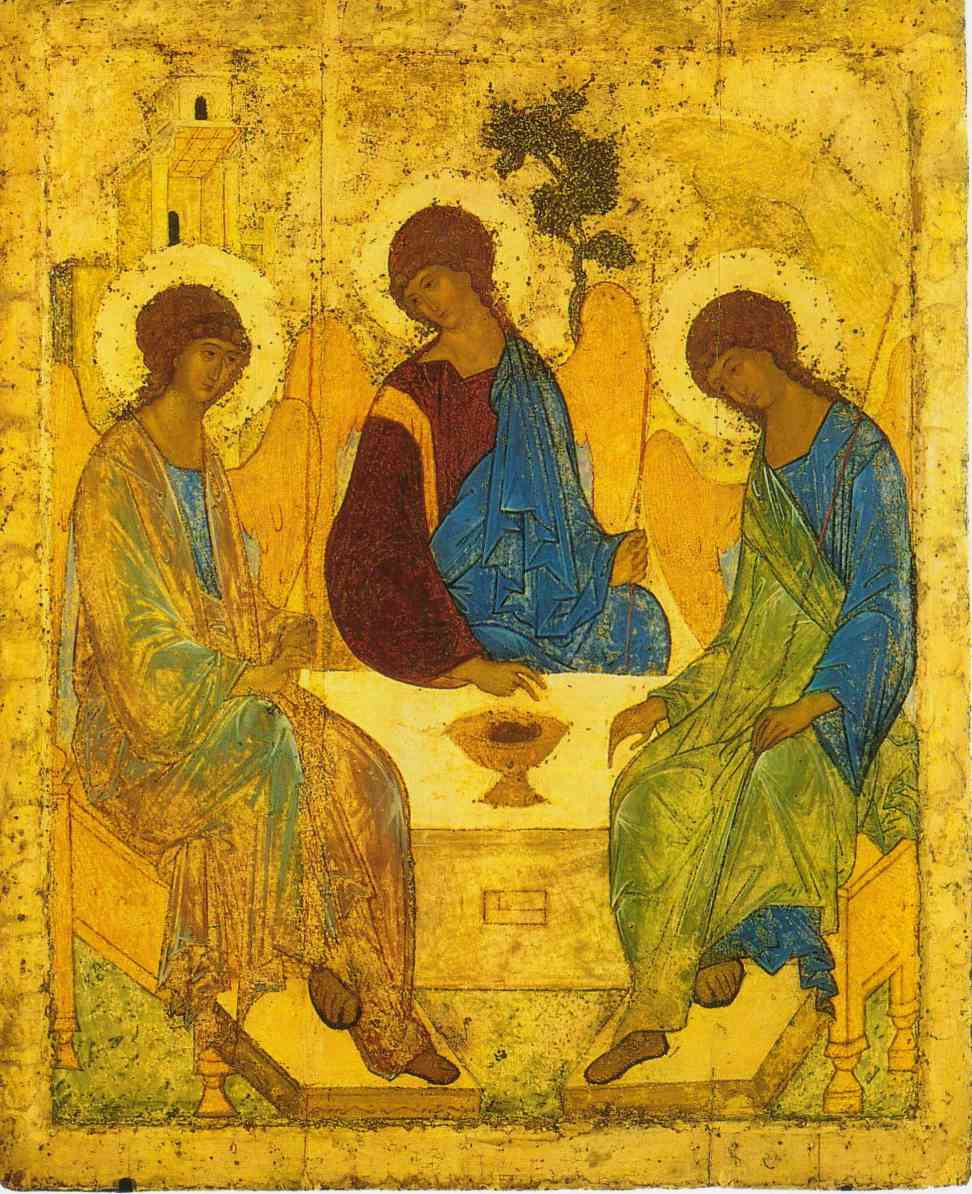
The music had such an extraordinary force of reality that we realized, no longer by deduction, but by the impact on our hearts, that it could not have originated from nothingness, but could only have come to be through the power of the Truth that became real in the composer's inspiration. Isn't the same thing evident when we allow ourselves to be moved by the icon of the Trinity of Rublëv? In the art of the icons, as in the great Western paintings of the Romanesque and Gothic period, the experience described by Cabasilas, starting with interiority, is visibly portrayed and can be shared.

In a rich way Pavel Evdokimov has brought to light the interior pathway that an icon establishes. An icon does not simply reproduce what can be perceived by the senses, but rather it presupposes, as he says, "a fasting of sight." Inner perception must free itself from the impression of the merely sensible, and in prayer and ascetical effort acquire a new and deeper capacity to see, to perform the passage from what is merely external to the profundity of reality, in such a way that the artist can see what the senses as such do not see, and what actually appears in what can be perceived: the splendor of the glory of God, the "glory of God shining on the face of Christ " (2 Corinthians 4:6).

To admire the icons and the great masterpieces of Christian art in general, leads us on an inner way, a way of overcoming ourselves; thus in this purification of vision that is a purification of the heart, it reveals the beautiful to us, or at least a ray of it. In this way we are brought into contact with the power of the truth. I have often affirmed my conviction that the true apology of Christian faith, the most convincing demonstration of its truth against every denial, are the saints, and the beauty that the faith has generated. Today, for faith to grow, we must lead ourselves and the persons we meet to encounter the saints and to enter into contact with the Beautiful.

Now however, we still have to respond to an objection. We have already rejected the assumption which claims that what has just been said is a flight into the irrational, into mere aestheticism.

Rather, it is the opposite that is true: This is the very way in which reason is freed from dullness and made ready to act.

Today another objection has even greater weight: the message of beauty is thrown into complete doubt by the power of falsehood, seduction, violence and evil. Can the beautiful be genuine, or, in the end, is it only an illusion? Isn't reality perhaps basically evil? The fear that in the end it is not the arrow of the beautiful that leads us to the truth, but that falsehood, all that is ugly and vulgar, may constitute the true "reality" has at all times caused people anguish.

At present this has been expressed in the assertion that after Auschwitz it was no longer possible to write poetry; after Auschwitz it is no longer possible to speak of a God who is good. People wondered: Where was God when the gas chambers were operating? This objection, which seemed reasonable enough before Auschwitz when one realized all the atrocities of history, shows that in any case a purely harmonious concept of beauty is not enough. It cannot stand up to the confrontation with the gravity of the questioning about God, truth and beauty. Apollo, who for Plato's Socrates was "the God" and the guarantor of unruffled beauty as "the truly divine" is absolutely no longer sufficient.

In this way, we return to the "two trumpets" of the Bible with which we started, to the paradox of being able to say of Christ: "You are the fairest of the children of men," and: "He had no beauty, no majesty to draw our eyes, no grace to make us delight in him." In the passion of Christ the Greek aesthetic that deserves admiration for its perceived contact with the Divine but which remained inexpressible for it, in Christ's passion is not removed but overcome.

The experience of the beautiful has received new depth and new realism. The One who is the Beauty itself let himself be slapped in the face, spat upon, crowned with thorns; the Shroud of Turin can help us imagine this in a realistic way. However, in his Face that is so disfigured, there appears the genuine, extreme beauty: the beauty of love that goes "to the very end"; for this reason it is revealed as greater than falsehood and violence. Whoever has perceived this beauty knows that truth, and not falsehood, is the real aspiration of the world. It is not the false that is "true," but indeed, the Truth.

It is, as it were, a new trick of what is false to present itself as "truth" and to say to us: over and above me there is basically nothing, stop seeking or even loving the truth; in doing so you are on the wrong track. The icon of the crucified Christ sets us free from this deception that is so widespread today. However it imposes a condition: that we let ourselves be wounded by him, and that we believe in the Love who can risk setting aside his external beauty to proclaim, in this way, the truth of the beautiful.

Falsehood however has another strategem. A beauty that is deceptive and false, a dazzling beauty that does not bring human beings out of themselves to open them to the ecstasy of rising to the heights, but indeed locks them entirely into themselves. Such beauty does not reawaken a longing for the Ineffable, readiness for sacrifice, the abandonment of self, but instead stirs up the desire, the will for power, possession and pleasure. It is that type of experience of beauty of which Genesis speaks in the account of the Original Sin. Eve saw that the fruit of the tree was "beautiful" to eat and was "delightful to the eyes."

The beautiful, as she experienced it, aroused in her a desire for possession, making her, as it were, turn in upon herself. Who would not recognize, for example, in advertising, the images made with supreme skill that are created to tempt the human being irresistibly, to make him want to grab everything and seek the passing satisfaction rather than be open to others.

So it is that Christian art today is caught between two fires (as perhaps it always has been): It must oppose the cult of the ugly, which says that everything beautiful is a deception and only the representation of what is crude, low and vulgar is the truth, the true illumination of knowledge. Or it has to counter the deceptive beauty that makes the human being seem diminished instead of making him great, and for this reason is false.

Is there anyone who does not know Dostoyevsky's often-quoted sentence: "The Beautiful will save us"? However, people usually forget that Dostoyevsky is referring here to the redeeming Beauty of Christ. We must learn to see him. If we know him, not only in words, but if we are struck by the arrow of his paradoxical beauty, then we will truly know him, and know him not only because we have heard others speak about him. Then we will have found the beauty of Truth, of the Truth that redeems. Nothing can bring us into close contact with the beauty of Christ himself other than the world of beauty created by faith and light that shines out from the faces of the saints, through whom his own light becomes visible.