Wednesday, March 11, 2009

hell is no other people


"Hell is other people." - Jean-Paul Sartre


This is the mantra, the codex, the thing to say and say again and again upon our 21st century rosary beads. No longer do we begin the prayers in the name of the Father, and of the Son, and of the Holy Spirit, we have adopted what Sartre says in his great play No Exit. We live by those words. Don't get me wrong....the play is poignant, the dialogue striking, and most importantly, he is an artist who crafts a reflection of our society's mindset. But do all of us really think as he does? Should we?

"If only that person were not in my life, I would be free of the shackles that hurt, offend, mock, ridicule or otherwise annoy me."


And so it is that we set up all sorts of filters, some literal, some metaphorical.
"I know what I'll do--I'll block that soul who has scorned me for the last time".....and thanks to gmail and yahoo, we are all set for saying good riddance.

"Hell is other people, for other people hurt us."

This is our superficial understanding, and it is carrying more and more of us to our graves with each passing moment, it would seem. We are dying with lists of those who are untouchables to us, those whom we wished did not exist. And yet, despite all of our walls, booby traps, and blind spots, these who should not be named do exist. In shirking reality and passing over them in our view, we are poisoning our own vision. We systematically close our eyes to various corners occupied by those sad souls, to the point where our own eyes are forced to remain closed all of the time-a sort of inversion of A Clockwork Orange-and we wonder why we have wasted away.

Now please, do not get me wrong. I have stewed in anger in my time, that is for sure, and perhaps I am akin to the choir preaching to the rest of the world. Wishing someone had never come into my life has consumed my soul and I have seen this mantra lived out consistently for periods stretching longer than my own life. I have told myself that I should and would never talk to someone again, after what they had said or done to me. And after those years or moments of retreat and aversion of my eyes, what safety have I gained? None. Instead it has wounded me in ways that I probably haven't even come close to grasping even after hours of introspection and reflection.

But there is something else that has come from this soul searching and meditation, and it is this-there is no pain or trauma that comes close to the searing wound of feeling absolutely nothing at all. I have wrestled with being called names that I will not utter here or anywhere. I have come up with my own names to call others in fits of rage and violence-those too won't be recalled here, there or anywhere. I have made people cry with these concoctions meant to tear down and destroy, these spells of obliteration. But none of that can be compared to the experience of utter disregard. To be in the midst of an abyss, where no one else is concerned with your life or death, that is to be in hell. Hell is to be with no other people. We can only hope and pray that Jean-Paul Sartre did not get what he wanted. For if he envisioned an old hotel room where he was truly alone, no amount of frustration with the flaws in his companions on this sojourn of life would be remembered, when he remembered his isolation and disconnection from this world that was meant to be entangled. The pain that we flee should not be fled--it must be understood in the proper light, not numbed with the correct proportion of neglect, chemicals, or therapy sessions.

In the midst of this murmuring and confusion, I see a voice, and a face. Ironically, he too was named Jean-Paul, though we Americans called him John Paul while he walked among us. He was not only mocked by others, he had his actual flesh ripped open by a bullet which flew into his body. When he saw that man who shot him, he remembered and chose to live by His friend's statement which at times it seems is nonexistent in our world.

"Forgive us our trespasses, as we forgive those who trespass against us."

Pope John Paul II was able to meet face to face with the man who tried to end his life. He even said, "pray for my brother, whom I have sincerely forgiven." And we in our pettiness bicker over issues such as who gets what when someone dies, or whether someone approves of our way of living? Oh, the travesty and tragedy...What are you willing to do to end the hell of separation and isolation? What have you created that has barred you from closeness with others?

If you do nothing at all, you may be following the other John Paul, but you will have wound up nowhere as a result.

No man is an island. That thought outweighs any poignant play in a heartbeat, if we would but consider its ramifications.

Monday, March 9, 2009

and while i'm busy loving mana.....


It's almost enough to get you pochos and gabachos to learn el idioma de conquistadores....almost....


Cómo quisiera poder vivir sin aire
Cómo quisiera vivir sin agua
Me encantaría
Querete un poco menos
Cómo quisiera poder vivir sin ti

Pero no puedo siento que muero
Me estoy ahogando sin tu amor

Cómo quisiera poder vivir sin aire
Cómo quisiera calmar mi aflicción
Cómo quisiera poder vivir sin agua
Me encantaría robar tu corazón

Cómo pudiera un pez nadar sin agua
Cómo puidera un ave volar sin alas
Cómo puidera la flor crecer sin tierra
Cómo quisiera porder vivir sin ti

Pero no puedo siento que muero
Me estoy ahogando sin tu amor

Cómo quisiera poder vivir sin aire
Cómo quisiera calmar mi aflicción
Cómo quisiera poder vivir sin agua
Me encantaría robar tu corazón

Cómo quisiera lanzarte al olvido
Cómo quisiera guardarte en un cajón
Cómo quisiera borrarte de un soplido
Me encantaría matar esta canción

sigue lloviendo


No Ha Parado De Llover
Maná


Desde que te perdí
La luz se ha puesto muy mojada
mirada triste esta nublada
Y en mis ojos no ha parado de llover

Solo y ya sin ti
Me tienes como un perro herido
Me tienes como un ave sin su nido
Estoy solo como arena sin su mar

Quien detendra la lluvia en mí
Oh no, no
Se me ha inundado el corazón
Quien detendra la lluvia en mi, oh mi amor
Solo tú puedes pararla

Sigue lloviendo, le sigue lloviendo al corazón
Dime que diablos voy a hacer
Sigue lloviendo, le sigue lloviendo al corazón
Y en mis ojos no ha parado de llover

No te comprendo, no entiendo que paso
Si te di todo, quizás te di de mas
Dime que falto, dime que sobro, dime que paso
Pero dime algo, que me estoy muriendo

Quien detendra la lluvia en mi, oh no, no
Se me ha inundado el corazón
Quien detendra la lluvia en mi, oh mi amor
Solo tu puedes pararla.

Sigue lloviendo, le sigue lloviendo al corazón
Dime que diablos voy a hacer
Sigue lloviendo, le sigue lloviendo al corazón, oh no no
Y en mis ojos no ha parado de llover, yeah yeah

Sigue lloviendo, le sigue lloviendo al corazón
Dime que diablos voy a hacer
Sigue lloviendo, le sigue lloviendo al corazón
Y en mis ojos no ha parado de llover
No para de llover
No ha parado de llover oh no no

Saturday, March 7, 2009

if I WERE to be critical, it would sound something like this....


There There

in pitch dark i go walking in your landscape.
broken branches trip me as i speak.
just because you feel it doesnt mean it's there.

there's always a siren
singing you to shipwreck.
(don't reach out, don't reach out)
steer away from these rocks
we'd be a walking disaster.
(don't reach out, don't reach out)

just because you feel it doesn't mean it's there.
(there's someone on your shoulder)
just because you feel it doesn't mean it's there.
(there's someone on your shoulder)

there there

why so green and lonely?
heaven sent you to me.

we are accidents
waiting waiting to happen.

we are accidents
waiting waiting to happen.

Thursday, March 5, 2009

1, 2, 3, 4....who's ? what's the score??


This second song (which has 2 renditions for your viewing and listening pleasure) is 99.3% relevant to my life:


Been hearing about you.
All about your disapproval.
Still I remember the way I used to move you.
I wrote you a letter.
I heard it just upset you.
Why don't you tell me?
How can I do this better?

Are you out there?
Do you hear me?
Can I call you?
Do you still hate me?
Are we talking?
Are we fighting?
Is it over?
Are we writing?

We're getting older.
But we're acting younger.
We should be smarter.
It seems we're getting dumber.
I have a picture
of you and me in Brooklyn.
On a porch, it was raining.
Hey, I remember that day.
And I miss you

Amen, Br. Merton


Do not depend on the hope of results. You may have to face the fact that your work will be apparently worthless and even achieve no result at all, if not perhaps results opposite to what you expect. As you get used to this idea, you start more and more to concentrate not on the results, but on the value, the rightness, the truth of the work itself. You gradually struggle less and less for an idea and more and more for specific people. In the end, it is the reality of personal relationship that saves everything.

"so what does it all mean?" (indeed)

Wednesday, March 4, 2009

it actually is casimir pulaski day today...

For some reason, I am full of questions. Why is that? Oh yes, I forgot....I am a scientist and my life and death hinges upon asking questions. And not only must I ask questions, but they must be the right ones. Asking a wrong question is almost worse than doing nothing at all. Or is it?
Why Sufjan Stevens would name this song Casimir Pulaski day intrigues me. Did the death of his friend occur on this day (March 4th is the feast day of St. Casimir, patron saint of Poland and Lithuania)? Is that alone sufficient? Is there something to this saint's life and death that makes a tragic death especially poignant (he was only 25 when he died, after all)? Does Sufjan Stevens even know about the history of St. Casimir? Or is this all coincidental? Am I ignorant of the impact that Polish culture has on the midwest? Surely this last question is the most important one to be answered in our immediate context of the song about St. Casimir. But I forgot to ask you--have you heard it? No? Well, even if you have, listen again, por favor.


Golden rod and the 4H stone,
The things I brought you
When I found out you had cancer of the bone.

Your father cried on the telephone
And he drove his car into the Navy yard
Just to prove that he was sorry.

In the morning, through the window shade
When the light pressed up against your shoulder blade
I could see what you were reading.

All the glory that the Lord has made
And the complications you could do without
When I kissed you on the mouth.


Tuesday night at the Bible study
We lift our hands and pray over your body,
But nothing ever happens.

I remember at Michael's house
In the living room when you kissed my neck
And I almost touched your blouse.

In the morning, at the top of the stairs
When your father found out what we did that night
And you told me you were scared.

All the glory when you ran outside
With your shirt tucked in and your shoes untied
And you told me not to follow you.


Sunday night when I cleaned the house
I found the card where you wrote it out
With the pictures of your mother.

On the floor at the great divide,
With my shirt tucked in and my shoes untied
I am crying in the bathroom.

In the morning when you finally go
And the nurse runs in with her head hung low
And the cardinal hits the window.

In the morning in the winter shade
On the first of March, on the holiday,
I thought I saw you breathing.


All the glory that the Lord has made
And the complications when I see His face
In the morning in the window.

All the glory when He took our place
But He took my shoulders and He shook my face.
And He takes and He takes and He takes.


The lyrics to this song itself raise many questions. Is Stevens writing from the perspective of the doubter? Or is his viewpoint that of the person full of the most faith of all? The one who can be shaken at their shoulders and face, and not shut out that message, but incorporate such pain and suffering into a larger scheme where God is good, is the one who truly believes. The one who does not demand the world to go their way is the one who grasps their infinitude. But is all contentment apathetic? Or is there room for happiness which rises above the here and the now to contemplate the infinite, and so be content with whether He gives or He takes? To censor this message of questioning is to cease to be, for when questions cease one lacks the faith of a little child, and this is no mere lack, it is one where the little child's clamors are turned away. This is a positive tragedy, not a mere dire dirge dedicated to dearth.

And yet, the question arises, what of those many souls we know who have gone from questioning in a child's tone, to questioning in a plaintive one? Is there a line of delineation between the thinking that is childlike and the thinking that is religulous? Will Occam's razor cut the soul who is too eager to use it? Or does this take us back to asking whether there is such a thing as wrong questions? I think it does. But again, the question I have is: is it not the heart that matters most? Regardless of the questions asked, if the heart is there, it is not only unshakeable, it itself will ask any question without fear of its world being turned upside down. This is why we see young children asking us why the sky is blue. And why did we ever stop asking such questions? Questions, questions, questions.

Saturday, February 28, 2009

Hallelujah

The struggles of faith weigh upon my mind to the point where when I succumb to those struggles, I feel paralyzed. One of my own thoughts this Lent is to be immersed in others. Abandon thoughts of self and then one can truly live. The paradox is timeless and true. It is not so much that I am struggling about doubt throughout the day, but when they come to mind these matters cast a shadow upon me and possess my soul as though it were me in the fires of doubt. I want to be there like the Lord who saw the three righteous men in the trials recorded by Daniel, and pull them out.

But I know too well that those journeys often do not leave me unscathed. When I go in, we all leave with charred clothes. I walk into the fire and stumble, kicking sparks up and smoldering smoke into my own eyes as I try to rescue others. Oftentimes, I realize that I need someone else to fix the mess I created.

In this current meditation, I've fixed my attention on one songwriter whose toils and confusions are played out in public for all to see. At some point last summer, I posted a video of him showing the conflict of playing one of his own songs and commented on his trial of faith. He once wrote words of praise to the Trinity, always honest about his shortcomings, but unashamed to play songs such as Be Thou My Vision. Now he will not play his own song, and his cover songs are more concerned with frailty and doubt.

What is amazing to me is that if you listen to the second song, which was composed by another soul in doubt, you still see the almost inescapable desire to praise God. The songwriter ended his set with this second song at an amazing house performance that myself and 3 others went together to see. Accompanied by no more than 31 other paying souls (and there weren't too many unpaying ones, by my count), and some great beer from Lost Abbey, we heard this troubadour, this bard, this hymnwriter, explain his struggles of faith.

It was then that it struck me again, that many struggles of conscience and faith are not what they are. Or perhaps they are what they are, but their implications and consequences aren't what we've been told that they were. Despite the weakness of our faith, it is not all about us in the end anyway. We must realize this or we will enter a spiral of despair. There is a dark night for our soul, and if we do not embrace it and struggle as Jacob once did, we are doomed.

So please, enjoy the first song which he wrote, and the second which he has in many ways adopted as his own. And when you are done with that, please take whatever praise that is genuine and within you, and do not discard it. As weak as it seems, it is not rubbish. And though it is Lent and our liturgies tend to exclude the Alleluia, I can't help but say thanks to God for any cry to Him, even from the doubtful soul.

It reminds me of another story where two friends were dealing with their own flavors of doubt. In that story, they went to a church they had never attended and met a priest who was busy gardening--trying to get the last weed pulled before saying his prayers, he hardly seemed fit to praise, to the undiscerning eye at least. These two strangers were called upon to lead the singing of the Psalms in a chant that only one had ever heard (and only a few times at that), with the third man prostrating himself and bowing before an Eastern altar. All the while, the two were supposed to keep their tempo and tune in check. I assure that that did not happen, but there were no other earthly souls there to poke fun. What the angels and saints did at the moment, oh Lord I wish I could know. Somehow, as weak as that moment was, it was just as beautiful as the most well-orchestrated service that had been planned for weeks. If sincerity was lacking in that perfectly memorized performance, perhaps the two fish out of water made an offering that pleased the Lord even more than than the 30 person choir that only sung out of a desire for applause.

But really, this blog was supposed to be about two songs. They may not resonate with every soul like Amazing Grace, but at times I wonder if every soul does need to hear words of unbending confidence. There is a dark night for every soul, of this I am convinced. Do not fear the struggle, fear the corpses which no longer struggle.


i could hear the church bells ringing
they pealed aloud your praise
the member's faces were smiling
with their hands outstretched to shake
it's true they did not move me
my heart was hard and tired
their perfect fire annoyed me
i could not find you anywhere
could someone please tell me the story
of sinners ransomed from the fall
i still have never seen you, and somedays
i don't love you at all

the devoted were wearing bracelets
to remind them why they came
some concrete motivation
when the abstract could not do the same
but if all that's left is duty, i'm falling on my sword
at least then, i would not serve an unseen distant lord

could someone please tell me the story
of sinners ransomed from the fall
i still have never seen you, and somedays
i don't love you at all
if this only a test
i hope that i'm passing, cuz i'm losing steam
but i still want to trust you

peace be still (x3)


Now I've heard there was a secret chord
That David played, and it pleased the Lord
But you don't really care for music, do you?
It goes like this
The fourth, the fifth
The minor fall, the major lift
The baffled king composing Hallelujah
Hallelujah
Hallelujah
Hallelujah
Hallelujah

Your faith was strong but you needed proof
You saw her bathing on the roof
Her beauty and the moonlight overthrew you
She tied you
To a kitchen chair
She broke your throne, and she cut your hair
And from your lips she drew the Hallelujah


You say I took the name in vain
I don't even know the name
But if I did, well really, what's it to you?
There's a blaze of light
In every word
It doesn't matter which you heard
The holy or the broken Hallelujah

Hallelujah, Hallelujah

I did my best, it wasn't much
I couldn't feel, so I tried to touch
I've told the truth, I didn't come to fool you
And even though
It all went wrong
I'll stand before the Lord of Song
With nothing on my tongue but Hallelujah

Hallelujah, Hallelujah
Hallelujah

Thursday, February 26, 2009

Introducing Called to Communion:Reformation Meets Rome


I'm very happy, excited, and amazed to announce that yesterday a new website was born. It's one that I'm involved with in various ways-the one visible proof that you can see at the moment is a podcast interview. In the future I think the mathoms will have a more mathom-esque tone than it did in the past because of this new site-I'll be writing more essayish articles there, roaming about the comboxes, critiquing my co-authors work, etc.--here can be for, well, the rest of life. But I digress. We were talking about the new site.

Called to Communion is put together by 10 or so guys (we need a female contributor, methinks) who have a similar past, a similar present, and hopefully a similar future.

We have journeyed through life and have spent varying amounts of time in appreciation of the Reformation for its desire for being close to the Apostles and their teachings, and yet we have also come to see that many of the protests made by Protestants were not sufficient reasons to stay separated from the Roman Catholic Church. We look back fondly on our days as Reformed/Calvinist believers, and we want to show how that makes sense. Please take a visit from this site today--it's still in its infancy but there is already much to see-our common goal of Christian unity and mutual understanding is being sent from mere mental activity to communication. Also note that there are comment sections for the posts, etc. Well, you get the gist-enough of my blathering about.

Have a great day, as we journey towards Pascha/Easter.

Saturday, February 21, 2009

the mathoms redivivus


You have entered this site for the first and the hundred and first time, whether you are some happenstance hobbling stranger who is hoping for something new and interesting to read, or my closest friend who knows that nothing of the sort will come from here. For that matter, I never promised anything of the sort-just read the banner here, and my mission statement will be clear: the celebration of the mathoms.

Two hundred and forty posts could have packed a wallop if quantity was all you were seeking, but that would leave the soul of the truly starving wanting more. There is no satiation without the substance, the marrow, the juice.

When pragmatism has conquered idealism, we wake up with sick stomachs and throbbing heads, and even worse maladies. But if all that is left is duty, I am not falling on my sword, I am making a change to see beyond duty and arrive at life itself.

Everything is gone, yet all things remain on the same course. It is the course we dreamed of as children, the one we spurned as fools of 13, or 31. But at 1331, we will see things clearly, doubtless. This is how we brighten our days, by not ignoring the darkness or embracing it as shining, shimmering splendor (yes, I did just quote Aladdin, and no, of course I did not!). It is knowing that Nothing is truly no thing. It is having the courage to laugh at those who take nothing for something, but only if such laughter begins with auto-mockery that ends in a joyful self-destruction. At that moment, when we feel like our walls have been dashed to pieces, we will realize that we can begin to build something real. Something, instead of nothing. That is the essence of a mathom. It is something true, something real, something held onto but is not the most amazing treatise or love letter. It may evoke real nostalgia, real guilt, real joy, or real bitterness, but the point is it is real. There are stronger potions in the world, and I will leave it for sorcerors and soothsayers to prattle with such words, because I have seen more good come from a miniscule mathom. The most meagre trifle in the proper place can unseat lords and dethrone kings. Even nothing can shake up world affairs. Whether that means it is for good or for ill is for historians to sort out, but it happens all the same.

There is in Nothing something so majestic and so high
that it is a fascination and spell to regard it. Is it not that
which Mankind, after the great effort of life, at last attains, and
that which alone can satisfy Mankind's desire? Is it not that which
is the end of so many generations of analysis, the final word of
Philosophy, and the goal of the search for reality? Is it not the
very matter of our modern creed in which the great spirits of our
time repose, and is it not, as it were, the culmination of their
intelligence? It is indeed the sum and meaning of all around!

How well has the world perceived it and how powerfully do its
legends illustrate what Nothing is to men! - Hilaire Belloc, On Nothing & Kindred Subjects

For now, I will say goodbye by saying hello:welcome back. It has been too long, even if it has only been five seconds.

Friday, February 20, 2009

Tuesday, February 17, 2009


Thursday, February 12, 2009

A parable on a passing parent

There was once a caring father who raised 4 wonderful children. Three were boys and one was a girl. The youngest boy clung closest to his parents of all, having been born as one out of season. In their wisdom from having failed in many ways to be a shining example to the first three, the little lad was favored by his parents' tempered experience with the adult children, who had all moved out of the house. The father made it a point to write dutifully to each of his children. They received personalized letters on birthdays and other special occasions. These were no Hallmark contrivances that could be exchanged between millions of fathers of myriads of children with no difference in the end. Instead, every line, every dot, was traced with the intention of a man who knew of the unique fibre that differentiated each special gift from God given to him.

The letters that he wrote were not merely personalized, they contained strokes of the finest genius. The advice was to the individual, and yet the children felt that they could share these handwritten words to their siblings, or to their friends, or even to some stranger who looked like they might need inspiration. The words were truly inspired, to the point that each brother and sister would call the other who had been fortunate enough to receive the latest work of art from their dearest dad, just to hear what he had to say.

They would read it all, and as the letter would come to a close, his trademark signature would say, "And always remember, dear one, that what I write to you here needs to be kept close to your heart. Keep it just as close to your heart as the words that I once whispered in your ear when you still dwelt under my roof, for you are never far from me. Love, DAD"

It was amidst these times of serenity and love that one night, the father died softly in his sleep. The four children could scarcely fathom a world without dad. His words of advice were like a matrix of being, a grid through which all things made sense. From the scrapes and cuts that made riding a bike seem like torture, to the broken hearts from a folly-filled crush, he had set them straight time and time again. And now he was not there to brush them off and remind them of their life's meaning that was often shouted down from the varying voices of a confused society. Never again would he stoop down and pick them up when they had no will to stand again.

And in this deep sadness, the letters that had swirled and been passed from brother to sister flew in a flurry, like some unbridled storm that would destroy homes and leave order in utter chaos.

One son told his sister that their father cared most about poetry. The second brother had said that his father wouldn't care so much about prose and rhyme as compared to diligence and honesty. The sister thought it was a waste of time to debate the two but to keep both poetry and fruitfulness in mind at the same time.

But our youngest friend, the kid brother, did not have those stories and tales on his mind. The memory of his dad's strong arms holding him close, kissing him with words of reassurance, kept his mind full of hope. His tears of mourning were intermingled with tears of joy and thanksgiving, just to have spent some moments with this marvelous man who brought them into this world and sustained them as they went from childhood to adulthood. This was such a strong experience that while he too kept the different letters of his father that he'd received throughout the years, the words themselves were drowned out by tangible memories that were unattached to paper and pen. And these remembrances were not merely things that brought about emotional flashbacks of the happy times when his dad was around-no, they were also words of advice as practical as that unread manual to whatever the electronic device du jour happens to be.

And so it was, that as the four friends and siblings sat at the funeral of their father, when the youngest child told his brothers and sister about some of his father's last words to him, and how that should shape their understanding of how to live out the rest of their lives in his absence, his stories were not met with empathy and interest. Instead, they held up the letters that they loved to read, and found many things in his stories that could not be reproduced in those amazing letters.

"But why didn't he write those words to me? Why would he say those things to you but never commit them to the written word?", or some permutation of that plaintive cry, came from each of the three older siblings. In their own unique ways, they each saw this little brother as a usurper who wanted to steal the spotlight of the truth imparted by their loving father.

"Please, dearest ones, remember what he would write to us all...he would say, 'Always remember, dear one, that what I write to you here needs to be kept close to your heart. Keep it just as close to your heart as the words that I once whispered in your ear when you still dwelt under my roof, for you are never far from me.'"

"NONSENSE! If we can't find the very thoughts of our Dad in one of his beautiful letters to at least one of us, we can't believe that what you have to say is from him. It's a figment of your imagination. We're sad that he's gone too, but that doesn't give you the right to just pretend like he would say something to you that he didn't put into writing! Dad was an organized guy, how would he leave out these ideas from his letters??"

And so it was that the youngest boy lived his life out in the hope that what his father had told him was real, and the three elder siblings shut him out, fearing his words that their father had said more than what they could hold. This phantasmal promise seemed impossible to them, and they shut their hearts to his words. They would all die with a piece of their father's legacy ungrasped-the paradox of them loving his words but shunning his parting words that ended each of his letters would not go unnoticed, by some at least.

Always remember, dear one, that what I write to you here needs to be kept close to your heart. Keep it just as close to your heart as the words that I once whispered in your ear when you still dwelt under my roof, for you are never far from me.


It reminds this very weak and amazingly meagre narrator of another writer's words to his "children". That man, Saul of Tarsus, is not known to have had four children, physically at least. But he did write in a parallel fashion when he said to a church in Asia Minor that inhabited a small city called Thessalonica:
So then, brothers, stand firm and hold to the traditions that you were taught by us, either by our spoken word or by our letter.


Whether spoken word or through Scriptures, the Scriptures call us to hear the words of the Apostles. If we claim that Sola Scriptura is a good principle to live by, are we going to our graves with our ears partially closed to those words of the very pages that we claim to honor? As paradoxical as it may sound, it would seem that those words themselves point to something MORE, in calling us to follow tradition. If we really want to honor the One who inspired those words, we must find the way to follow what is said, even if it takes us beyond those words.

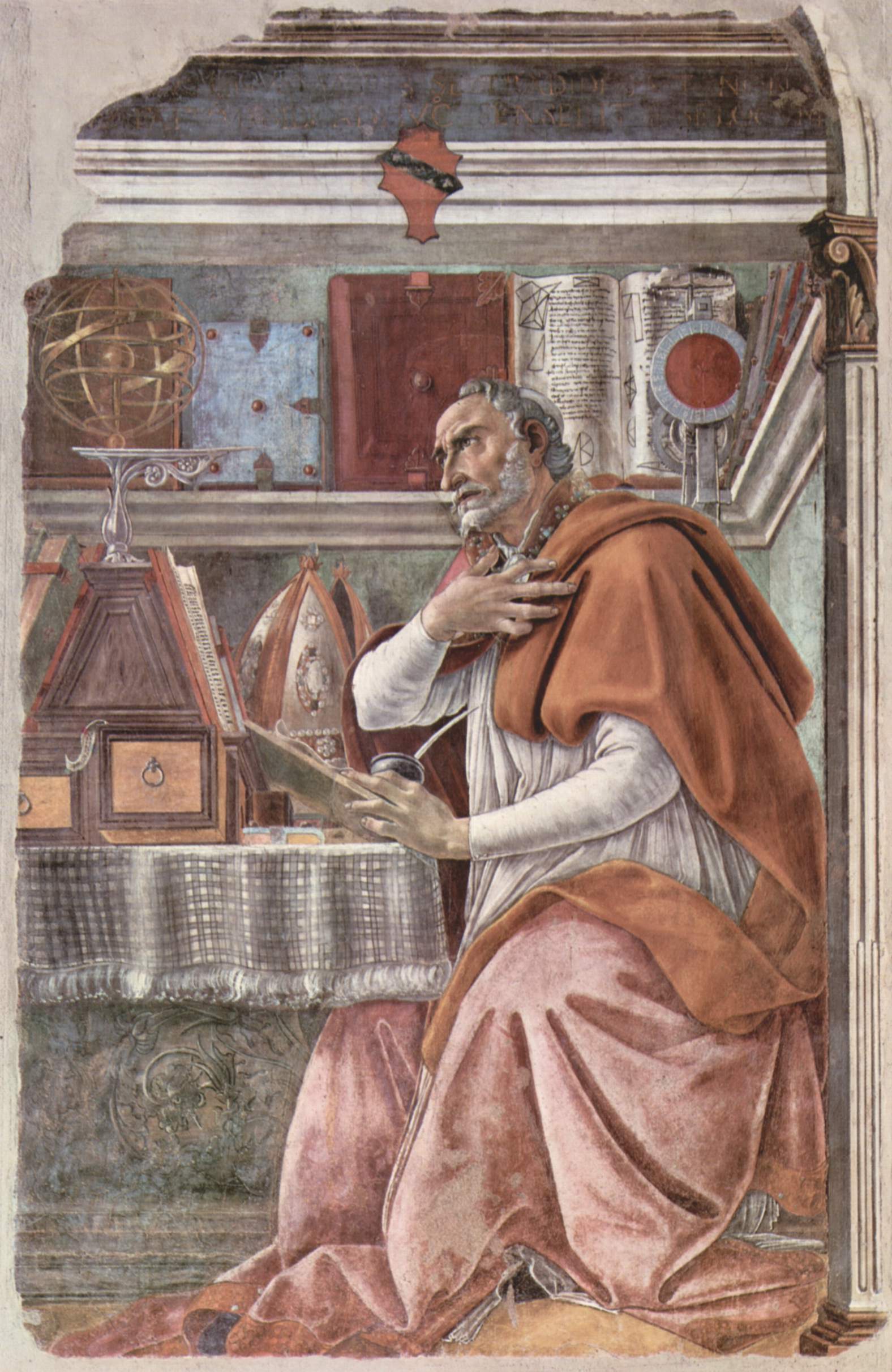
Augustine the schizophrenic?

Having entered the Catholic Church through a Presbyterian door (which looked quite worn and used as I turned back and noted its handle), I often think of the confusion that this must make for my friends and the barely observing public. In a sense, it seems like the least likely thing for a person to do, when one considers the Presbyterian staunch stance and claim of being the closest thing to the original Reformation thinkers who broke with Rome. At the same time, some of my more Evangelical-minded friends think of this change as one of the most likely things a person could do, because of its interest in the covenant. This inclusiveness which extends God's grace to the unwilling children is seen as some sort of crime against the will, or a presumption upon God where He is construed to be a pathetic genie. Forced to dole out His grace, we hold Him at gunpoint and our children are blessed without a profession of faith.

You get the (horrible) picture.

This macabre mix of hatred and flirtation with Catholicism in the Reformed mindset takes flesh and blood in one historical character, St. Augustine of Hippo.


This great thinker is also maliciously maligned in a way similar to how I often have felt, for he has at once been bearer of the brunt of the blame for causing Calvinism and Catholicism.

Take this quote from Dave Hunt, who wrote against Calvinism by saying:


In 386, after studies in philosophy, law and the classics (he was greatly inspired by Plato), a year of teaching grammar and a career as a rhetorician, Augustine embraced Christianity, entered the Roman Catholic Church, and established a monastery which he moved to Hippo, Africa upon being appointed its bishop. Often called the father of Roman Catholicism’s major doctrines, as we shall see, Augustine heavily influenced later philosophers and even exerts a strong influence among evangelicals today through Calvinism (p. 23).


Here we see Augustine as the prototype of two things that are supposed to be diametrically opposed, if the Calvinist is correct.

How can we settle this matter? One tactic is to take Augustine and turn him into two people. By dividing his later works from his earlier work, we can have him say two things that clash with each other. Take this quote from Norman Geisler, who objects to the claim that there is historical basis for Calvin's thinking.

We have been defending a moderate form of Calvinism. This view is not new. Its roots are found in the early writings of St. Augustine…St. Augustine's earlier view was a more moderate form of what I have called extreme Calvinism. In our opinion, had Augustine not been thrown off track by his view of baptismal regeneration and the coercion of heretics to believe (during the Donatist controversy), extreme Calvinists would find no substantial support in the whole history of the Christian church up to the Reformation (CBF, 129-130).


Why does he stress the early works of St. Augustine? There he wrote on the will and freedom in such a way that it would seem to make him sound "Arminian", and as a result, Geisler aligns himself with the "early" Augustine. The "later" Augustine was too Calvinistic for his ears. To the Calvinist, "later" Augustine was just right. He had grown with time and had shaken off his childish ways of believing in the ontological freedom of the will.

But really, is Augustine a schizophrenic? Did he change with time?

I would answer, "No" to the first question, and "Yes but not towards contradiction" to the second question. Ah, but I'm arguing from the Catholic perspective, so I must be biased, right?

Actually, there is a very simple way to check if those who break up Augustine's work are doing him justice. Thankfully, the habits of the great ancient writers included the task of composing retractions. Sometimes this was not a literal statement of "I have erred", but more a matter of saying "I could have said this better. If I could write this book again, I would treat the matter thusly." But retractions very well could include a statement denouncing earlier statements. At any rate, Augustine published his retractions towards the end of his life, and what did he have to say about his alleged two selves?


In actuality, there was no substantial retraction of his early or his later work. To Augustine at least, this whole matter of dividing him asunder makes as much sense as Solomon's threat to the women who debated over the maternity of one baby. Augustine was not a schizophrenic.


Now, the real question one must consider after all of this is--is there a way to embrace both the early and the late Augustine at the same time? How does this work. My answer would be, here:


Can't you just imagine Pope Benedict XVI saying, "Come Join Us"?

Here we have the mystery maintained - God's sovereignty, man's responsibility.
So in a sense, the Arminians and the Calvinists are both right about Augustine. The charge that (especially early) Augustine spoke too highly of the will for Calvinist ears is true, but it is also true that in his later writings he is too willing to praise God's sovereignty for Arminian ears.


Augustine was not divided against himself, for such a house (and by extension, such a person) shall not stand.

But I'll leave the explanation of how I think it all works out for another time...

Monday, February 2, 2009

the pillar of truth-but that's not in there part III


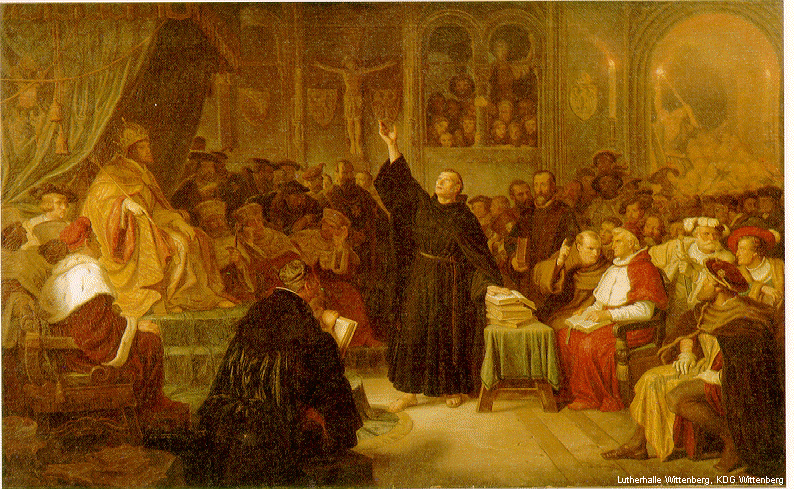
Here I stand, I cannot do otherwise! God help me, Amen!


According to this website (among others), that may not have been actually spoken by Luther. What seems to be without a doubt is that he did say this:

"Unless I am convicted by scripture and plain reason - I do not accept the authority of the popes and councils, for they have contradicted each other - my conscience is captive to the Word of God. I cannot and I will not recant anything for to go against conscience is neither right nor safe. God help me. Amen."

Those are words of courage, and they are quite moving. They form a rallying cry around the idea of Sola Scriptura. Actually, if you think about his reference to plain reason there is quite a lot of wiggle room, but to most people, he's touting the Protestant party line here.

But what do the Scriptures themselves say about themselves?

Yes, His Word is a lamp unto our feet, a light unto our path. And yes, Paul wrote in his second letter to Timothy:

"
All Scripture is God-breathed and is useful for teaching, rebuking, correcting and training in righteousness, so that the man of God may be thoroughly equipped for every good work."

When it comes down to whether there might be authority beyond the Scriptures, these and other concepts about the Scriptures are placed before our eyes, by Luther and his successors.

But what do the Scriptures say about the source of truth?
In the first Letter that Paul wrote to Timothy, we hear a description that escaped my eyes (well, my heart at least) that goes against this notion that one can only find truths in the Scriptures.

Paul wrote:
"Although I hope to come to you soon, I am writing you these instructions so that, if I am delayed, you will know how people ought to conduct themselves in God's household, which is the church of the living God, the pillar and foundation of the truth."


Did you catch that? Did you let those words sink in beyond a surface reading?

The Church is the pillar and foundation of the truth.

Again, as I survey those congregations from whence I have come, I don't see a way for this concept to really exist. I looked within the walls and had to conclude again, "But that's not in there!"

Now, there are hundreds of objections and the like that one must make, like where does the Church subsist? Are there degrees of truth? I'm not here to answer such questions today, I'm merely here to point out that there is something woefully lacking, something that comes from an understanding of the Body of Christ as something that is only right when we think it's in line with our understanding of the Scriptures.

If this were the case, the Scriptures would be the pillar and foundation of the truth. But that's not what Paul said, is it? No, somehow, the Church is that pillar.

Sunday, February 1, 2009

best super bowl ad ever


This ad was rejected by NBC for being too political.
2 thoughts:
1) I can relate to our current president.
2) It's too bad this wasn't aired.

the sourdough bread proof of apostolic succession


Yesterday at California Adventure, we wanted to be sure that we were adequately fed beyond our remaining Christmas Disney gift cards. And so it was that we went to both the Mission Tortilla Factory and the Boudin Sourdough Bread Factory tours, which include silly videos and (more importantly) free samples from these {somewhat} fine establishments.

I'd gone to the tortilla one multiple times given my palate's preference, but this time we wanted a fuller experience, and so we ended up sitting through a horrible dialogue with Rosie O'Donnell and some actor that I knew I was supposed to know to gain some sort of credibility, but thank the Lord I care not a dram for such status.

At any rate, my protest to the surroundings did not lead me to pay no attention at all. Instead, at any educational moment, etc., my eyes and ears were open. The video described how sourdough was made, contrasting it from other bread that is only based on yeast for its fermentation. Instead, there is (in the case of Boudin) a patented species of Lactobacillus that gives sourdough bread its distinctive qualities, especially its sourness.

You can read more about sourdough bread here, but the main point that I have today is that one other important thing about sourdough is that a big portion of its existence is what's called mother dough or starter dough.

That is, with each new batch of bread that is baked, a portion of the mix is kept to be used to make the next generation of bread. This is to the point where for things made by Boudin bakeries one can trace the formulation back to the likely very humble beginnings of this now huge company.

As I heard about the great continuity in this recipe that is attainable through mother dough in sourdough baking, I realized that this was a great picture of what Catholic, Anglican, and Orthodox Christians see in their belief in Apostolic Succession.

There is something that is passed from bishop to bishop. It is no intangible notion of doctrinal "purity", which is a notion that has such a shifting definition that if you asked 10 scholars you'd get 20 opinions. Instead, those of us who hold to apostolic succession would say that there was something to Paul's words to Timothy--something that goes beyond the paltry realm of mere human allegiance, and enters the world of an amazing call of God that would keep His people from doubt in a world of too many options. It takes one to a realm where there is a flavor/recipe/taste that has the chance to be preserved in a world that shifts like sand.

The question is, do you view baking as something where each new creation is separate from the previous recipe? Can there be retooling in each generation? Are there even generations, or do we constantly "emerge" with each new group of believers? If there is no such continuity, how do we know that our gospel today is the same as that of yesterday? I looked at the world, with its dissension and failure to converge, and realized that there had to be something beyond pundits and scholars. There needed to be a gift to God's people that didn't just go from Paul to Timothy, but to us today in this painfully confusing 21st century. And so, like the Boudin bakers who have kept not only their recipe the same but the actual substance of their bread, I would challenge you all to answer this question: where is your mother dough?

Thursday, January 29, 2009

the Church is visible--But that's not in there!!! pt.2


PCA pastor Jason Stellman makes the point I've been wanting to make for some time in a post entitled On Pleasantville and the Visible Church:

"Once we have sufficiently convinced ourselves that the visible church is small enough only to contain those who are under the authority of our particular denomination or body, then we can allow passages like Matthew 16:19 to play a significant role in our ecclesiastical practice. When someone becomes unrepentantly delinquent in doctrine or morals, we exercise our proper jurisdiction and remove such a one from our assembly.

But while all of this painful, sober, and faithful discipline happens we have this nagging thought in the back of our minds that the excommunicated person can just run out and join one of many other churches in the area, and that the chances that those churches will take seriously our disciplinary sentence are slim to nil. So he’s not really “delivered over to Satan,” but delivered over to Lakeside Community Church.

My point is two-fold. First, Protestantism doesn’t really believe in a visible church but in visible churches, and secondly, it is only in the context of any one of these distinct churches that spiritual authority and discipline make any sense."

He has a spot-on analysis coming from the place where I stood just 4 months ago.
If Jesus wanted Christians to gather together into multiple bodies willy-nilly, there would be the confusing situation we are in today. The ability to deliver the disobedient to Satan, to shun those who cause divisions, etc. etc. is made to be something where one group of Christians say "Yes, Brother X is a brother in good standing" while the others say "No, Brother X is in trouble."

So just as the Gospels call for celibacy among at least some brethren, and I tried to argue "Hey, but that's not in there!," I would also argue that church discipline has no real teeth outside of a Church that is ultimately visible and one. The ideal set forth by Christ is doomed to fail, if we are supposed to be split based on baptism, communion, church government, soteriology, music, and the color of the drapes.

Lord, heal us of our division as a group so that we can be healed of our many weaknesses as individuals.