Wednesday, May 14, 2008


Tuesday, May 13, 2008
The Stone Caster
The crushed grass and sandy earth crumbled in their fingers, as they sifted for rocks that would kill the girl who had defied the all-holy law of Moses. She had been caught in adultery, in the very act, or so they said as a crowd of many came to see justice done. But where was the man with whom she did the deed? No response was offered. All that mattered was that they had the girl. Maybe it's because the girls are the real temptresses. Surely no man could be held responsible for falling for a glance full of thirst, a thirst for pleasure. And so, the sages and scholars had gathered to make sure that none would be drawn by her cords of kindness again. The rocks were collected, and it was a mere matter of aiming and putting one more sinner in their grave. And surely, this grave would not make the rolls of heaven come judgment day.
But it was not to be-for the Teacher who had crossed their stage at the brink of this woman's execution more than once had some thoughts about who could be worthy of executing judgment, and who ought first consider their own sins.
This prophet, priest and soon to be king also knelt down to touch the land, but with different purposes. Instead of gathering the tools of a murderer or executioner, he began to write upon the earth. Many sages and philosophers have wondered what it was that the Teacher wrote, but at the end of the day, the girl was spared. She was to go and sin no more, and most likely she didn't obey his sage advice. But she was spared nonetheless.
Years later, some would also ask whether this tale was contrived, added into later editions of the Holy Books. Maybe some were sneaking in desires to make capital punishment atrocious to the conscience, or maybe the pens of the scribes wanted to spice up Scripture with salacious tales of misdeeds and lust.
Again, we can wonder whether this happened or not, but no one wonders whether the Teacher had words to say to those in power in the religious sphere.
For passage after passage utters words that would make an honest reader who reads with their mind open and not anesthetized want to vomit. To call someone a whitewashed tomb that is rotting away is to conjure images of decaying flesh, complete with wriggling worms doing their best to decompose the carcass of a pillar of the committee.
Or how about the words that state that these men were blind leaders of the blind, who caused children to stumble, and as such are worthy of having a huge stone tied around their necks? They would be surely lost, sleeping with the fishes, mafia style.
Oh those Pharisees--the name itself is now synonymous with all that is hypocritical and self-justifying. Can anything good come from them? Are they the new Nazareth that was once the disdained home of the nobodys and vagrants of the first century?
And that is where the story turns to a page that we have not read, but we can see the effects. Maybe some other scribes failed to fill in these lines to the gospels, but we can see too clearly that the thinking of many would lead one to another story.
Imagine the scene of the adulteress, nearly killed but thankfully the hands the Pharisees have been stayed by the simple conviction of Christ's statement. The scrolls are unrolled, and what would we read in this lost scene?
Some will easily note the poor writing quality that would make this fragment of a lost gospel unbelievable. And I too would be on your side were you to form a committee in opposition to this accretion to the word of God.
But again, I'd ask you to venture to those days. Put yourself in the sandals of a first century Palestinian and imagine the landscape of power politics at play, where the Pharisees are standing their ground in the face of a man who could do miracles and lay claim to certain birth characteristics that would point at him as Messiah.
To have failed to see the light here would make most people assume that their words were vain puffs of smoke in the imagination of man's pride and vanity.
But is that what we read in the holy Gospels?
With the actual passages such as the whitewashed tombs and blind leaders of blind, one might assume this to be the whole picture. But as usual, we humans in our own blindness and extremism would be missing something enormous, for the whole picture speaks more words than these about the Pharisees.
For the shocking reality is that interwoven between the denunciations of Christ is a staunch affirmation of these religious leaders.
In the gospel of St. Matthew, Christ says something that I had overlooked for thirteen years, until it was recently brought to my attention.
Christ said these poignant words that have not left my mind for several months--
For years I had read this passage and focused on the horrible burdens placed on God's people by the Scribes and Pharisees. Again, the notion of a blanket condemnation of these men seemed to be the only way to look at the institution of religious leaders in Israel. But what Christ actually says in the beginning is quite the opposite. He commended the people to practice and observe whatever the Pharisees and scribes told them to do! But how could this be? According to Jesus, there was something special about this seat of Moses, that seems to have ensured that what was said by the scribes and Pharisees was worthy of following, despite the fact that these individuals had not believed in Jesus.
These words have led me to see that in many sense I too have been a Pharisee, for I have sought to cast stones at another institution of religious leaders. They have been appointed from generation to generation from the initiation of the Christian Church, and in my faithlessness and cynicism I have assumed that their status meant nothing. And as I think on these words I am coming to see that there has always been a special protection on the religious leaders, from the Pharisees' day to our own. Surely, it is no protection from hypocrisy and horrible deeds, and the histories of the world are replete with examples of such tragedies. But at the end of the analysis, I cannot see how this hypothetical lost gospel where Christians ignored Christ's words by ignoring the words of the Pharisees would not be the same as what many Christians have done.
For Christ himself said that he was going to build a Church. If Moses' seat could have a special protection, how could the new lawgiver of the covenant written on our hearts establish a worse government, by founding it without a similar protection?
But it was not to be-for the Teacher who had crossed their stage at the brink of this woman's execution more than once had some thoughts about who could be worthy of executing judgment, and who ought first consider their own sins.
This prophet, priest and soon to be king also knelt down to touch the land, but with different purposes. Instead of gathering the tools of a murderer or executioner, he began to write upon the earth. Many sages and philosophers have wondered what it was that the Teacher wrote, but at the end of the day, the girl was spared. She was to go and sin no more, and most likely she didn't obey his sage advice. But she was spared nonetheless.
Years later, some would also ask whether this tale was contrived, added into later editions of the Holy Books. Maybe some were sneaking in desires to make capital punishment atrocious to the conscience, or maybe the pens of the scribes wanted to spice up Scripture with salacious tales of misdeeds and lust.
Again, we can wonder whether this happened or not, but no one wonders whether the Teacher had words to say to those in power in the religious sphere.
For passage after passage utters words that would make an honest reader who reads with their mind open and not anesthetized want to vomit. To call someone a whitewashed tomb that is rotting away is to conjure images of decaying flesh, complete with wriggling worms doing their best to decompose the carcass of a pillar of the committee.
Or how about the words that state that these men were blind leaders of the blind, who caused children to stumble, and as such are worthy of having a huge stone tied around their necks? They would be surely lost, sleeping with the fishes, mafia style.
Oh those Pharisees--the name itself is now synonymous with all that is hypocritical and self-justifying. Can anything good come from them? Are they the new Nazareth that was once the disdained home of the nobodys and vagrants of the first century?
And that is where the story turns to a page that we have not read, but we can see the effects. Maybe some other scribes failed to fill in these lines to the gospels, but we can see too clearly that the thinking of many would lead one to another story.
Imagine the scene of the adulteress, nearly killed but thankfully the hands the Pharisees have been stayed by the simple conviction of Christ's statement. The scrolls are unrolled, and what would we read in this lost scene?
No one cast a stone at the adulteress, for the Pharisees knew that they were in far greater sin for having doubted whether Jesus was the Christ. And it came to pass that the Pharisees said unto Jesus, "Teacher, you say that you are wise, and that he who is without sin should cast the first stone. Therefore, if you are without sin, why have you not cast the stone?"
And Jesus responded, "It is written, 'Vengeance is mine, I shall repay.'"
Whereupon the Pharisees were shunned by Christ and his followers, and the disciples never paid heed to the words of the Pharisees again. When they entered the synagogues and the Temple, the disciples would close their ears if a scribe or Pharisee spoke, out of fear of the Lord. Simon Peter and other disciples sought to stone them, but Jesus bade them to stay their hands. And much fear was upon the people.
Some will easily note the poor writing quality that would make this fragment of a lost gospel unbelievable. And I too would be on your side were you to form a committee in opposition to this accretion to the word of God.
But again, I'd ask you to venture to those days. Put yourself in the sandals of a first century Palestinian and imagine the landscape of power politics at play, where the Pharisees are standing their ground in the face of a man who could do miracles and lay claim to certain birth characteristics that would point at him as Messiah.
To have failed to see the light here would make most people assume that their words were vain puffs of smoke in the imagination of man's pride and vanity.
But is that what we read in the holy Gospels?
With the actual passages such as the whitewashed tombs and blind leaders of blind, one might assume this to be the whole picture. But as usual, we humans in our own blindness and extremism would be missing something enormous, for the whole picture speaks more words than these about the Pharisees.
For the shocking reality is that interwoven between the denunciations of Christ is a staunch affirmation of these religious leaders.
In the gospel of St. Matthew, Christ says something that I had overlooked for thirteen years, until it was recently brought to my attention.
Christ said these poignant words that have not left my mind for several months--
The scribes and the Pharisees sit on Moses’ seat, so practice and observe whatever they tell you— but not what they do. For they preach, but do not practice. They tie up heavy burdens, hard to bear, and lay them on people’s shoulders, but they themselves are not willing to move them with their finger. Matthew 23:2-4
For years I had read this passage and focused on the horrible burdens placed on God's people by the Scribes and Pharisees. Again, the notion of a blanket condemnation of these men seemed to be the only way to look at the institution of religious leaders in Israel. But what Christ actually says in the beginning is quite the opposite. He commended the people to practice and observe whatever the Pharisees and scribes told them to do! But how could this be? According to Jesus, there was something special about this seat of Moses, that seems to have ensured that what was said by the scribes and Pharisees was worthy of following, despite the fact that these individuals had not believed in Jesus.
These words have led me to see that in many sense I too have been a Pharisee, for I have sought to cast stones at another institution of religious leaders. They have been appointed from generation to generation from the initiation of the Christian Church, and in my faithlessness and cynicism I have assumed that their status meant nothing. And as I think on these words I am coming to see that there has always been a special protection on the religious leaders, from the Pharisees' day to our own. Surely, it is no protection from hypocrisy and horrible deeds, and the histories of the world are replete with examples of such tragedies. But at the end of the analysis, I cannot see how this hypothetical lost gospel where Christians ignored Christ's words by ignoring the words of the Pharisees would not be the same as what many Christians have done.
For Christ himself said that he was going to build a Church. If Moses' seat could have a special protection, how could the new lawgiver of the covenant written on our hearts establish a worse government, by founding it without a similar protection?
Friday, May 9, 2008
The issue of immigration
Como el águila en vuelo
como la fiera en celo
desafiando fronteras
defendiendo el honor
he pasado la vida explorando
otras tierras para darles a mis
hijos un mañana mejor.
Si la muerte me alcanza en su loca
carrera envuelto en mi bandera que me
lleven allá, que me canten el himno de
mi patria diez meses o me muero dos
veces si me entierran acá.
De paisano a paisano del hermano
al hermano por querer trabajar, nos
han hecho la guerra patrullando
fronteras no nos pueden domar.
De paisano a paisano del hermano
al hermano ese hombre es llorar,
como duele la patria cuando llora
mi raza llanto internacional.
*De paisano a paisano antes de seguir
cantando yo le pregunto al patrón, quien
recoge la cosecha quien trabaja en la
limpieza hoteles y restaurants y
quien se mata trabajando en construcción
mientras el patrón regaña tejiendo la
telaraña en su lujosa mansión.
Muchas veces ni nos pagan, para que
sale la llaga como sale envenenada
nos echan la inmigración si con mi
canto pudiera derrumbaría las fronteras
para que el mundo viviera con una
sola bandera en una misma nación*.
De paisano a paisano del hermano
al hermano por querer trabajar, nos
han hecho la guerra patrullando
fronteras no nos pueden domar.
De paisano a paisano del hermano
al hermano ese hombre es llorar,
como duele la patria cuando llora
mi raza llanto internacional.
Wednesday, May 7, 2008
Gentle reminders of my location.
The DC area often presents itself as the pinnacle of all that is haute. And perhaps that's not inaccurate, but the point is, it is truly in denial of its Southern roots. Now, one could argue that to be Southern is to be cultured, and that may be true in an ideal sense. But let's get back to terra firma in MMVIII, year of Our Lord.
So there I was sitting on the metro going to downtown DC yesterday, when what did I spy but this ad?

Ah yes, sweet tea and fried food for breakfast. That sounds more like the South than a bunch of lawyers in expensive suits looking down their noses on public transportation. We all know the real power players would be flown in, but for whatever reason everyone thinks they are everyone in this town. If only they'd read the writing on the wall, perhaps they'd be put back into their true place in this world. Of course, I'm not advocating actually purchasing anything from this establishment that should be disestablished, but you get my drift. And if you don't, kindly drift onto another site.
So there I was sitting on the metro going to downtown DC yesterday, when what did I spy but this ad?

Ah yes, sweet tea and fried food for breakfast. That sounds more like the South than a bunch of lawyers in expensive suits looking down their noses on public transportation. We all know the real power players would be flown in, but for whatever reason everyone thinks they are everyone in this town. If only they'd read the writing on the wall, perhaps they'd be put back into their true place in this world. Of course, I'm not advocating actually purchasing anything from this establishment that should be disestablished, but you get my drift. And if you don't, kindly drift onto another site.
Sunday, May 4, 2008
You Already Believe in Purgatory
I was reading St. Augustine's City of God yesterday, considering his arguments for how the Christian faith was not mocked despite the fact that Rome was sacked by invading hosts, when a seemingly unrelated concept became quite clear.
In book I chapter VIII, he discusses how trials and judgments themselves do not produce a lack of faith or faith in and of themselves. The real question is who the person suffering is. Let me stop summarizing and quote a portion of the chapter here:
As I read this, it struck me that in many senses this is proof that all Christians believe in purgatory. The common objection to it is that Christ forgave our sins on the cross, and that any further suffering is therefore unnecessary. But that overlooks the roots of the word purgatory. Just as Augustine mentions that affliction "proves, purges, clarifies" the good, it's true that forgiven people still suffer on this earth. And woe if you think that it is purposeless suffering....life would be utterly meaningless if there was no positive end result of the negative things we often endure.
And yet, that is exactly the Catholic doctrine of purgatory. In technical terminology, it would state that "temporal punishments due to sins" are inflicted through this intermediate state, but on a more philosophical level, it's what all Christians understand, albeit intuitively at times.
We are full of vices that we wish would leave us, and at moments of trials we come closer in our faith and trust in God. While the struggle will never end on earth, we long for the day when that struggle will cease. So what is so unnatural about positing that if someone were to die with loads of consequences due to sin within their soul, that they would be purged after death in the same way that this happens on earth? This is, of course, keeping in mind the fact that this person is forgiven in a "legal" sense-in fact, if there was no beginning of God's good work in us, how could there be a completion that is not only whatever state one happens to be in at death, but is truly and really complete, where we are just as holy as Christ himself? What is unnatural about saying that that person would be glorified through a purging of any bad thing that was sown?
When bad things happen many evangelicals will interpret this by saying that this is a sad result of "reaping what you sow". Likewise, it strikes me that if someone were to die without being fully transformed into the image of Christ that there must be a purgation. More standard Reformed/Protestant systematic theology would divide salvation into justification, sanctification, and glorification. But as I'm growing through my years I am seeing that these are not as isolated or cookie cutter as one would think. There is glory that comes to God's people as they grow up even before death, for example.
The point is that if one believes that glorification is true, one believes in purgatory. For to gain in glory is merely the converse of decreasing in shame-the shame that comes through prayerlessness, despair, wickedness, and the like. As for me, I hope that I go through some process that applies the objective truth of the Cross to my subjective self fully. Whether it's through growing wiser, the full apprehension of my mortality as I am dying, or through some intermediate state, or through a complex combination of these and other things as I would imagine it will be, I want to be more like Christ. And if that's what purgatory means, as I would argue, then all Christians already do believe in purgatory.

In book I chapter VIII, he discusses how trials and judgments themselves do not produce a lack of faith or faith in and of themselves. The real question is who the person suffering is. Let me stop summarizing and quote a portion of the chapter here:
Wherefore, though good and bad men suffer alike, we must not suppose that there is no difference between the men themselves, because there is no difference in what they both suffer. For even in the likeness of the sufferings, there remains an unlikeness in the sufferers; and though exposed to the same anguish, virtue and vice are not the same thing. For as the same fire causes gold to glow brightly, and chaff to smoke; and under the same flail the straw is beaten small, while the grain is cleansed; and as the lees are not mixed with the oil, though squeezed out of the vat by the same pressure, so the same violence of affliction proves, purges, clarifies the good, but damns, ruins, exterminates the wicked. And thus it is that in the same affliction the wicked detest God and blaspheme, while the good pray and praise. So material a difference does it make, not what ills are suffered, but what kind of man suffers them. For, stirred up with the same movement, mud exhales a horrible stench, and ointment emits a fragrant odor.
As I read this, it struck me that in many senses this is proof that all Christians believe in purgatory. The common objection to it is that Christ forgave our sins on the cross, and that any further suffering is therefore unnecessary. But that overlooks the roots of the word purgatory. Just as Augustine mentions that affliction "proves, purges, clarifies" the good, it's true that forgiven people still suffer on this earth. And woe if you think that it is purposeless suffering....life would be utterly meaningless if there was no positive end result of the negative things we often endure.
And yet, that is exactly the Catholic doctrine of purgatory. In technical terminology, it would state that "temporal punishments due to sins" are inflicted through this intermediate state, but on a more philosophical level, it's what all Christians understand, albeit intuitively at times.
We are full of vices that we wish would leave us, and at moments of trials we come closer in our faith and trust in God. While the struggle will never end on earth, we long for the day when that struggle will cease. So what is so unnatural about positing that if someone were to die with loads of consequences due to sin within their soul, that they would be purged after death in the same way that this happens on earth? This is, of course, keeping in mind the fact that this person is forgiven in a "legal" sense-in fact, if there was no beginning of God's good work in us, how could there be a completion that is not only whatever state one happens to be in at death, but is truly and really complete, where we are just as holy as Christ himself? What is unnatural about saying that that person would be glorified through a purging of any bad thing that was sown?
When bad things happen many evangelicals will interpret this by saying that this is a sad result of "reaping what you sow". Likewise, it strikes me that if someone were to die without being fully transformed into the image of Christ that there must be a purgation. More standard Reformed/Protestant systematic theology would divide salvation into justification, sanctification, and glorification. But as I'm growing through my years I am seeing that these are not as isolated or cookie cutter as one would think. There is glory that comes to God's people as they grow up even before death, for example.
The point is that if one believes that glorification is true, one believes in purgatory. For to gain in glory is merely the converse of decreasing in shame-the shame that comes through prayerlessness, despair, wickedness, and the like. As for me, I hope that I go through some process that applies the objective truth of the Cross to my subjective self fully. Whether it's through growing wiser, the full apprehension of my mortality as I am dying, or through some intermediate state, or through a complex combination of these and other things as I would imagine it will be, I want to be more like Christ. And if that's what purgatory means, as I would argue, then all Christians already do believe in purgatory.
on drinking, bouncers, and dissipation
I thought this was a tragically funny accurate depiction of man's folly with fermented beverages. Some of the impressions are poor in quality but his allegory is spot on (from what I have been told from third party sources only--ha).
Friday, May 2, 2008
Wednesday, April 30, 2008
April's Adventures in Books!
Looking back on April, I was able to read some great books while contemplating new career directions, having a daughter, and keeping up with the normal abnormality of my schedule. I hope to reread most of these books, they were so good (and deep!). I hope that the lessons from these writers old and new end up sticking on this tabula that is thankfully not rasa.
The Republic-Plato

This classic work of literature was one that I had for some time been ashamed to have said I'd never read. Additionally, a recent blog entry of a friend referenced it, so I knew I needed to get off of my laurels and read it. Of course, I'd read the excerpts dealing with the allegory of the cave, but to take the whole of his argument for what its worth, and to feel the dialogue's progress in its natural fashion took work, but the work was well worth it. While Plato espouses some things that are strange, such as the dissolution of marriage relations to the point where individuals would be unsure of the identity of their parents, in order to foster a more communal sense of society, his thoughts on truth and tyranny make striking points about our world today.
Christ the Lord-Out of Egypt

I had wanted to read this book for quite some time, and bought the paperback copy about a year ago. We finally got around to reading this book and it was quite enjoyable. It covers the period of Jesus' life as a seven year old, from the time when he left Egypt and returned back to Israel. The crux of the book deals with how Jesus as a human boy would come to understand his divine nature. For some time it made me feel slightly uncomfortable to think that it's possible that he would be unaware of who he was, but then as I thought from my child's perspective of not fully understanding his place in the universe, it made more sense. Ultimately, whether Rice's speculations are accurate or not on the level of details, she accurately applies the truth that the mystery of the Incarnation unites the human with the divine without mixture of substances. I can't wait to get the sequel, which deals with the life of Our Lord as a young man.
Don't Waste Your Life - John Piper

This small book by Baptist preacher John Piper deals with the fact that life is so short, and should not be wasted. It sounds obvious but the sad fact is that in our society so many people are wasting their lives. I was expecting more glaring commentary on the ways in which our society is guilty of this crime, especially as the back cover includes a great example of how most people think that an ideal retirement is spent doing nothing. However, it stays more focused on a positive view of life's meaning. Perhaps Piper's positivity is more palatable to more people, but it didn't get to me really.
What's Wrong With The World - G.K. Chesterton

This book has a very audacious title, with an even more bold message. In it, Chesterton critiques almost every facet of society, from government to family to education to feminism. While some of his views were shocking at first, he did his usual charm and opened my mind. At the end of the day, he argues that the ideal should be our basis for judging something. His closing thought that shows that our society is flawed based on the redness of a poor girl's hair is enough to make you want to cry because of the beauty of his writing, and the fact that we neglect the poor.
Biography of St. Thomas Aquinas - G.K. Chesterton

I finished the first book in this two-book volume this month, reading about the life and views of a man who has proven to be quite enigmatic. I had started reading R.C. Sproul's book Classical Apologetics, which explains the view of those who think Thomas Aquinas got things right. However, as I was reading I thought that it would be better to go straight to the source. When I saw how large most of Aquinas' books were, I realized I should stick with my current favorite writer, G.K. Chesterton, whose biography of St. Thomas has been hailed as the finest by such modern Thomists as Jacques Maritain and Etienne Gilson. At any rate, Chesterton's exposition of what Thomas accomplished made me hungry to learn more about this man's perspective on the world. Chesterton's grasp of the problems of philosophy is as wide as his view of the world, and I can only hope that my eventual readings of Aquinas are as exciting as Chesterton's take on the man and his project.
The Phenomenon of Life: Towards a Philosophical Biology - Hans Jonas

This collection of essays by Hans Jonas, former student of Heidegger who parted ways with him due to Heidegger's refusal to denounce Hitler, applies the basic principles of St. Thomas to the way most biologists look at life. His writing is quite dense with philosophical language [this sentence is a case in point: Concerning the single particle, then, the traceable steady presence in the continuum is the sole operational meaning of "identity", and the traced "path" is its complete verification: no obvious claim to an internal principle of identity, such as retentive historicity or protentive urge for "self"-preservation, issues from its manner of inert permanence.] This is definitely one that cannot simply be read, but must be reread as one goes, and as one thinks back to particular issues. My favorite essay was "Is God a Mathematician?" I think he raises many very important points when one considers theology and biology and the mess that often arises when they clash.
The Republic-Plato

This classic work of literature was one that I had for some time been ashamed to have said I'd never read. Additionally, a recent blog entry of a friend referenced it, so I knew I needed to get off of my laurels and read it. Of course, I'd read the excerpts dealing with the allegory of the cave, but to take the whole of his argument for what its worth, and to feel the dialogue's progress in its natural fashion took work, but the work was well worth it. While Plato espouses some things that are strange, such as the dissolution of marriage relations to the point where individuals would be unsure of the identity of their parents, in order to foster a more communal sense of society, his thoughts on truth and tyranny make striking points about our world today.
Christ the Lord-Out of Egypt
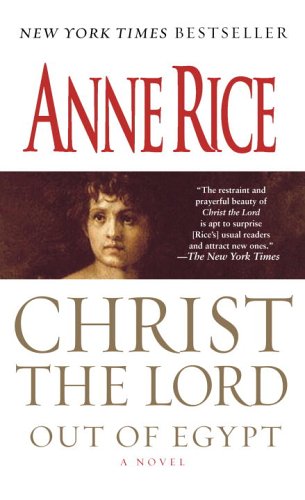
I had wanted to read this book for quite some time, and bought the paperback copy about a year ago. We finally got around to reading this book and it was quite enjoyable. It covers the period of Jesus' life as a seven year old, from the time when he left Egypt and returned back to Israel. The crux of the book deals with how Jesus as a human boy would come to understand his divine nature. For some time it made me feel slightly uncomfortable to think that it's possible that he would be unaware of who he was, but then as I thought from my child's perspective of not fully understanding his place in the universe, it made more sense. Ultimately, whether Rice's speculations are accurate or not on the level of details, she accurately applies the truth that the mystery of the Incarnation unites the human with the divine without mixture of substances. I can't wait to get the sequel, which deals with the life of Our Lord as a young man.
Don't Waste Your Life - John Piper

This small book by Baptist preacher John Piper deals with the fact that life is so short, and should not be wasted. It sounds obvious but the sad fact is that in our society so many people are wasting their lives. I was expecting more glaring commentary on the ways in which our society is guilty of this crime, especially as the back cover includes a great example of how most people think that an ideal retirement is spent doing nothing. However, it stays more focused on a positive view of life's meaning. Perhaps Piper's positivity is more palatable to more people, but it didn't get to me really.
What's Wrong With The World - G.K. Chesterton

This book has a very audacious title, with an even more bold message. In it, Chesterton critiques almost every facet of society, from government to family to education to feminism. While some of his views were shocking at first, he did his usual charm and opened my mind. At the end of the day, he argues that the ideal should be our basis for judging something. His closing thought that shows that our society is flawed based on the redness of a poor girl's hair is enough to make you want to cry because of the beauty of his writing, and the fact that we neglect the poor.
Biography of St. Thomas Aquinas - G.K. Chesterton

I finished the first book in this two-book volume this month, reading about the life and views of a man who has proven to be quite enigmatic. I had started reading R.C. Sproul's book Classical Apologetics, which explains the view of those who think Thomas Aquinas got things right. However, as I was reading I thought that it would be better to go straight to the source. When I saw how large most of Aquinas' books were, I realized I should stick with my current favorite writer, G.K. Chesterton, whose biography of St. Thomas has been hailed as the finest by such modern Thomists as Jacques Maritain and Etienne Gilson. At any rate, Chesterton's exposition of what Thomas accomplished made me hungry to learn more about this man's perspective on the world. Chesterton's grasp of the problems of philosophy is as wide as his view of the world, and I can only hope that my eventual readings of Aquinas are as exciting as Chesterton's take on the man and his project.
The Phenomenon of Life: Towards a Philosophical Biology - Hans Jonas

This collection of essays by Hans Jonas, former student of Heidegger who parted ways with him due to Heidegger's refusal to denounce Hitler, applies the basic principles of St. Thomas to the way most biologists look at life. His writing is quite dense with philosophical language [this sentence is a case in point: Concerning the single particle, then, the traceable steady presence in the continuum is the sole operational meaning of "identity", and the traced "path" is its complete verification: no obvious claim to an internal principle of identity, such as retentive historicity or protentive urge for "self"-preservation, issues from its manner of inert permanence.] This is definitely one that cannot simply be read, but must be reread as one goes, and as one thinks back to particular issues. My favorite essay was "Is God a Mathematician?" I think he raises many very important points when one considers theology and biology and the mess that often arises when they clash.
Tuesday, April 29, 2008
posting a Chesterton quote because I can
I was scanning through What's Wrong With The World, by G.K. Chesterton to post a quote onto our family site, when I realized that he had said something about marriage that I had meant to post some time ago. The words are so true. They were true when they were written in 1910 (just 2 years shy of the centennial anniversary!), but they are especially true in our time of ravingly mad divorce that runs rampant in our culture.
If I were you, I would think on these words for some moments, call a specific family that is dealing with divorce to mind, pray, and ponder how our society can come to a point where the rending of souls united is a more rare event.
But enough of my rambling--on to Chesterton.
If I were you, I would think on these words for some moments, call a specific family that is dealing with divorce to mind, pray, and ponder how our society can come to a point where the rending of souls united is a more rare event.
But enough of my rambling--on to Chesterton.
"The principle is this: that in everything worth having, even in every pleasure, there is a point of pain or tedium that must be survived, so that the pleasure may revive and endure. The joy of battle comes after the first fear of death; the joy of reading Virgil comes after the bore of learning him; the glow of the sea-bather comes after the icy shock of the sea bath; and the success of marriage comes after the failure of the honeymoon. All human vows, laws, and contracts are so many ways of surviving with success this breaking point, this instant of potential surrender.
In everything on this earth that is worth doing, there is a stage when no one would do it, except for necessity or honor. It is then that the Institution upholds a man and helps him on to the firmer ground ahead. Whether this solid fact of human nature is sufficient to justify the sublime dedication of Christian marriage is quite another matter, it is amply sufficient to justify the general human feeling of marriage as a fixed thing, dissolution of which is a fault or, at least, an ignominy. The essential element is not so much duration as security. Two people must be tied together in order to do themselves justice; for twenty minutes at a dance, or for twenty years in a marriage. In both cases the point is, that if a man is bored in the first five minutes he must go on and force himself to be happy. Coercion is a kind of encouragement; and anarchy (or what some call liberty) is essentially oppressive, because it is equally discouraging. If we all floated in the air like bubbles, free to drift anywhere at any instant, the practical result would be that no one would have the courage to begin a conversation. It would be so embarrassing to start a sentence in a friendly whisper, and then have to shout the last half of it because the other party was floating away into the free and formless ether. The two must hold each other and do justice to each other. If Americans can be divorced for "incompatibility of temper" I cannot conceive why they are not all divorced. I have known many happy marriages, but never a compatible one. The whole aim of marriage is to fight through and survive the instant when incompatibility becomes unquestionable. For a man and a woman, as such, are incompatible."
{emphasis added}
Monday, April 28, 2008
But what about Paraguay?
The first book that I read which gives an analysis of the Reformation and Catholicism from the Catholic perspective is Louis Bouyer's The Spirit and Forms of Protestantism.
The book is highly engaging and has brought up many of the core issues that have importance when one considers the church. One drawback about the book that has been evident in reading it a second time out loud is that Bouyer is so well-read that one has to know the scholars of whom he speaks. While he cites Calvin and Luther at length, most of what he says about Barth and Kierkegaard is based on the assumption that one has a good understanding of these writers. The main thrust of his themes is still able to be grasped, but sometimes he lists French writers that were famous in France but I've often no clue who they are.
He also has the sort of grasp on history that I hope to have some day. For instance, he argues that if one is to grasp that the ultimacy of God's glory is something sought after by both devout Catholics and Calvinists, one can see that the fundamental application of these concepts of this are true in a political realm. For, he argues, if one compares Calvin's Geneva, at least as conceived ideally, with the work of the Jesuits in Paraguay, then one will find some striking similarities.
So, what about Paraguay? Ignorant American that I am, when I read those words, they did not say too much to me. I had recently read about where this small country is, nestled in a landlocked state between Brazil and the larger South American countries like Argentina. And it's true I did note in passing fancy that it was interesting that the vast majority of the population is bilingual, speaking both Spanish and Guarani, the native American dialect of the area. But I failed to see any religious significance.
Now, since Louis Bouyer had mentioned Paraguay, I looked up the Jesuit connection with Paraguay. This link is one of probably hundreds discussing the matter, but I will at least say that superficially I am very excited about this notion. Often one hears of the empires built by Europe as those which decimate culture and language in the name of religion, but the fact that the Jesuits did not discourage the use of the native language in this instance hints that this may not be a universal rule.
It also raises the question that always was on my mind--was the oppression that occurred historically wrought by the hands of religious men and women, or was it done by opportunistic individuals? It seems that Paraguay is not only an anomaly in terms of relative frequency among countries established in the Americas, but also with regard to the fact that in this country the religious Jesuits had more power and less competition with thrill/gold/fame-seeking conquistadores. So which model of preaching is the exception, and which is the rule? In the sense that a rule is based on a standard or ruler, it would seem that Paraguay would be the way in which one ought to gauge the merits of the religion that was spread to new cultures. There was a philosophy underlying this mission, that was able to permeate more due to less competition with those not in the clergy. But we seem to emphasize the stark and frightening acts of man that are based on no principles that a man would boast of to his children. We think that because they are more shocking they say more. But that would only be true if the motives underlying those deeds were ultimate to those individuals. This seems to be yet another instance where we as a society have things backwards.
The book is highly engaging and has brought up many of the core issues that have importance when one considers the church. One drawback about the book that has been evident in reading it a second time out loud is that Bouyer is so well-read that one has to know the scholars of whom he speaks. While he cites Calvin and Luther at length, most of what he says about Barth and Kierkegaard is based on the assumption that one has a good understanding of these writers. The main thrust of his themes is still able to be grasped, but sometimes he lists French writers that were famous in France but I've often no clue who they are.
He also has the sort of grasp on history that I hope to have some day. For instance, he argues that if one is to grasp that the ultimacy of God's glory is something sought after by both devout Catholics and Calvinists, one can see that the fundamental application of these concepts of this are true in a political realm. For, he argues, if one compares Calvin's Geneva, at least as conceived ideally, with the work of the Jesuits in Paraguay, then one will find some striking similarities.
So, what about Paraguay? Ignorant American that I am, when I read those words, they did not say too much to me. I had recently read about where this small country is, nestled in a landlocked state between Brazil and the larger South American countries like Argentina. And it's true I did note in passing fancy that it was interesting that the vast majority of the population is bilingual, speaking both Spanish and Guarani, the native American dialect of the area. But I failed to see any religious significance.
Now, since Louis Bouyer had mentioned Paraguay, I looked up the Jesuit connection with Paraguay. This link is one of probably hundreds discussing the matter, but I will at least say that superficially I am very excited about this notion. Often one hears of the empires built by Europe as those which decimate culture and language in the name of religion, but the fact that the Jesuits did not discourage the use of the native language in this instance hints that this may not be a universal rule.
It also raises the question that always was on my mind--was the oppression that occurred historically wrought by the hands of religious men and women, or was it done by opportunistic individuals? It seems that Paraguay is not only an anomaly in terms of relative frequency among countries established in the Americas, but also with regard to the fact that in this country the religious Jesuits had more power and less competition with thrill/gold/fame-seeking conquistadores. So which model of preaching is the exception, and which is the rule? In the sense that a rule is based on a standard or ruler, it would seem that Paraguay would be the way in which one ought to gauge the merits of the religion that was spread to new cultures. There was a philosophy underlying this mission, that was able to permeate more due to less competition with those not in the clergy. But we seem to emphasize the stark and frightening acts of man that are based on no principles that a man would boast of to his children. We think that because they are more shocking they say more. But that would only be true if the motives underlying those deeds were ultimate to those individuals. This seems to be yet another instance where we as a society have things backwards.
Friday, April 25, 2008
Tuesday, April 22, 2008
Earth Day
The world is viewed in too linear of a fashion at times; after all, it is a globe. Why not assume some things in this world are cycles? Lean years, fat years, make sure your fat ears are open if we are truly being destructive.
Then again, you tell me that our destruction is irreversible due to greenhouse gases, but if the world is full of more CO2 than before how would this not be more fuel for the fire of a tree's photosynthetic rate? Does an increase in CO2 do nothing to affect photosynthesis?
I'm asking sincerely, being not a skeptic but not a sheep on this issue.
The last time I checked, a greenhouse was for growing trees. How would greenhouse gases not turn the cycle back down towards less CO2 because of trees that reaped the benefit?
And what's going on in the realm of food rationing? There are too many questions, with even more answers (correct, incorrect, and just absolutely irrelevant).
Then again, you tell me that our destruction is irreversible due to greenhouse gases, but if the world is full of more CO2 than before how would this not be more fuel for the fire of a tree's photosynthetic rate? Does an increase in CO2 do nothing to affect photosynthesis?
I'm asking sincerely, being not a skeptic but not a sheep on this issue.
The last time I checked, a greenhouse was for growing trees. How would greenhouse gases not turn the cycle back down towards less CO2 because of trees that reaped the benefit?
And what's going on in the realm of food rationing? There are too many questions, with even more answers (correct, incorrect, and just absolutely irrelevant).
Friday, April 18, 2008
Thursday, April 17, 2008
Reflections as Time Passes
Life is so immeasurably important and so measurably short.
I have trudged through the soils of the earth seeking truths from molecules, and have gotten dirty in the process. Overwhelmed by my options, I want to arrive at a point of less divergences. There are many ways to skin a cat, but if you fight over how to get the job done like the trolls in the Hobbit, you'll invariably lose the ability to skin the cat.
So I take my blade and raise it to the sky and say that this is the way to end the battles, and hope that I get a chance to make a meal that provides sustenance to body and mind.
But will this hunt murder my conscience?
All signs say no, but voices around me murmur a hushed yes, don't do it.
I must shun the advice of others when the message of my heart says this is the right way. Dial a cliche.
I have trudged through the soils of the earth seeking truths from molecules, and have gotten dirty in the process. Overwhelmed by my options, I want to arrive at a point of less divergences. There are many ways to skin a cat, but if you fight over how to get the job done like the trolls in the Hobbit, you'll invariably lose the ability to skin the cat.
So I take my blade and raise it to the sky and say that this is the way to end the battles, and hope that I get a chance to make a meal that provides sustenance to body and mind.
But will this hunt murder my conscience?
All signs say no, but voices around me murmur a hushed yes, don't do it.
I must shun the advice of others when the message of my heart says this is the right way. Dial a cliche.
Monday, April 14, 2008

Saturday, April 12, 2008

Friday, April 11, 2008
august of 1995

A few weeks after this picture was taken the guitarist gave me an old bass that had been used by many others (I think Isaiah and Aaron Calles). His instructions explained the structure of the bass in terms of the strings being E, A, D, and G. So it's no wonder why I never progressed. But oh, the nostalgia of the time.
Almost 13 years have passed since then, and what has happened? Quite a bit, I would say.
Thursday, April 10, 2008
Subscribe to:
Posts (Atom)